Showing posts with label U.S. economy. Show all posts

Sunday, August 7, 2011

The S&P downgrade and the GOP's apparent disdain for America


Three things caught my eye this morning on the S&P downgrade of U.S. debt.

The first was the helpful timeline provided by Steve Benen at the Washington Monthly describing how we got to this point. Benen
provides facts that point to the Republicans as the villain in this drama. If you don't like his facts, offer your own, but do try to stick to facts.

The second is the comment by publisher Steve Forbes, a one-time GOP presidential hopeful, who said the following of the downgrade:

I think in a narrow sense it is a political move... an outrageous move. The government can pay its debts, it is legally obligated to do so, its got the wherewithal to do it. But I am surprised S&P would play politics -- the U.S. government can pay the interest and principle on the bonds -- but in a broader sense we do have severe economic troubles, but we will be able to pay the interest and principle on the bonds.

The third was Greg Sargent's comment that, holding aside whether we should give any credibility to the downgrade, it is hard to see how the Republicans can claim victory in any of this, citing the S&P report:

The political brinksmanship of recent months highlights what we see as America's government and policymaking becoming less stable, less effective, and less predictable, than we have previously believed. The statutory debt ceiling and the threat of default have become political bargaining chips in the debate over fiscal policy.

Despite this year's wide-ranging debate, in our view, the differences between political parties have proven to be extraordinarily difficult to bridge, and, as we see it, the resulting disagreement fell well short of the comprehensive fiscal consolidation program that some proponents have envisioned until quite recently. Republicans and Democrats have only been able to agree to relatively modest savings on discretionary spending while delegating to the Select Committee decisions on more comprehensive measures. It appears that for now, new revenues have dropped down on the menu of policy options. In addition, the plan envisions only minor policy changes on Medicare and little change in other entitlements, the containment of which we and most other independent observers regard as key to long-term fiscal sustainability.

As Sargent points out, S&P explicitly cites the GOP threat of default as leverage for policy ends as an indication American governance is becoming less stable and predictable.

To sum up: The downgrade was precipitated by clearly identifiable Republican actions over the past 30 years; it was a cynical, politically motivated action on the part of S&P; and, the current inability of Washington to effectively govern the nation can be traced to irresponsible GOP maneuvering beholden to a radical right-wing ideological agenda.

Obama is right on this one. The GOP drove the country into a ditch, have done everything they can to make sure the current administration can't get it back on the road, and are having great fun blaming the president for the shape we're in.

I am always amazed that Republicans claim the high ground on how much they love their country. It seems to me they have little claim to this high ground as long as they continue to be such an obstacle to improving the state of the nation. How else to explain their actions?

(Cross-posted at Lippmann's Ghost.)

Wednesday, August 3, 2011

Plain speaking: What President Obama should have said to the American people about the budget and the debt ceiling


This is the speech Obama should have given on Sunday night -- before he let the terrorists Republicans dance the hora all night. His polls would have gone up at least 20 points and his re-election would have been all but guaranteed. Americans may love hearing the words "tax cuts" (even when they're for 1% of the population), but they love their John Wayne character even more.

Ladies and gentlemen, the President of the United States:

Good evening.

As we all know, the U.S. government is scheduled to reach its limit for borrowing, or what has come to be known as the "debt ceiling" on Tuesday. The U.S. Congress, knowing full well the consequence of not increasing that limit would be economic chaos, has historically raised the ceiling under both Republican and Democratic administrations. This time, due to the intransigence of the opposition Republicans in the House, Congress has been unable to reach a compromise that would increase that limit. With a painful and catastrophic default staring us in the face, I am ordering the following steps to be taken:

Unless a clean bill raising the debt ceiling reaches my desk by Monday night, I will invoke the clause in the 14th Amendment to the Constitution that states, "The validity of the public debt of the United States, authorized by law, including debts incurred for payment of pensions and bounties for services in suppressing insurrection or rebellion, shall not be questioned" -- to raise the debt ceiling. As President of the United States, I cannot morally or financially let the United States default on its obligations. I cannot allow the actions of a small group of Representatives to push the entire American economy off a cliff. I cannot allow millions to suffer at the hands of a few. If you do not agree with this process or do not take well to the move I am undertaking and want to begin some sort of investigation into the legality of this procedure or even impose hearings for impeachment, let me quote our last Presiden: "Bring it on." I look forward to that fight.

After we ensure the continued flow of checks and payments, Congress and the Executive Branch will immediately begin discussion of the U.S. budget. To be blunt, these budget discussions will include spending cuts across the board, including defense, subsidies to the wildly profitable industries, and closing loopholes that exist only to enhance the re-election of specific Senators and Representatives, for example the corporate jet loophole. I cannot say what the figure will be, but every branch of government will be touched, including many of the perks enjoyed by Members of Congress.

The budget discussions will also include raising taxes on individuals and on corporations, especially those persons that make over $250,000 and corporations that have generated enormous profits yet pay minimal to nothing in taxes. Many of these individuals and corporations have profited greatly from the tax breaks and government bailouts over the past decade. It is time to review just exactly what this government largesse has truly cost a majority of the American people. The Bush tax cuts, which have cost over $400 billion and have not created any jobs, will not be renewed in their current form -- period.

These budget discussions will also include an in-depth examination of the cost to the American economy of sending jobs abroad and the creation of a public works program in conjunction with the private sector to rebuild our faltering infrastructure. The U.S. cannot compete in a world where jobs are shipped out of the country to save a few dollars and the rest of the world builds while applying band aid after band aid.

In addition, I am ordering Harry Reid and John Boehner to keep their respective constituents in session all month -- yes, I know it is August -- to hammer out the framework of a budget that I can sign, a budget that will truly demonstrate shared sacrifice across the board, a sacrifice that will not be based solely on those who cannot pay for high-priced lobbyists sent to D.C. to protect specific breaks and grants.

The past three years have not been a vacation for the American people, and therefore we, the men and women who these struggling Americans elected to shepherd in a better and stronger America, are not taking a vacation until we can agree on a true compromise to get our fiscal house in order.

Thank you.

Saturday, July 30, 2011

How do you kill the economy? Pass a balanced budget amendment.

Guest post by Publius

The House recently passed “Cut, Cap and Balance” (see John McCain’s fantastic take on it here). Republicans are convinced of the need for a balanced budget amendment, and one of the most cited arguments for they give for a balanced budget amendment is that 49 states have one so the federal government should too.

The concept of a balanced budget amendment sounds intuitive enough. “Ordinary Americans and 49 states have to balance their budgets,” the argument goes, “so Congress should too.” Well, not exactly.

First, there is a huge difference between the balanced budget “amendments” (several states have laws instead of constitutional amendments) at the state level and the proposed amendment at the federal level. The state amendments, for example, do not even attempt to balance the entire state budget. Instead, they almost exclusively only apply to a state’s “general fund.” The general fund oftentimes constitutes less than half of a state’s budget. It is the fund out of which general expenditures flow and into which general revenues enter. “Special” expenditures and revenues, such as gasoline taxes, education expenses, etc., have nothing to do with the general fund and are exempt from the balancing requirement.

If Congresspeople would stop and think about their argument for a moment, they would quickly realize that the balanced budget requirements at the state level either can’t apply to the entire budget or are laxly enforced. Most every single state is currently running a deficit, and has been for several years! Further analysis by these Congresspeople would also show the issue isn’t lax enforcement- at least exclusively.

In 1987, the Advisory Commission on Intergovernmental Relations published an oft-cited study (PDF) of state balanced budget requirements. The study examined each state’s budget balancing requirements and the mechanisms each used to enforce the requirements. It then ranked each state on a scale of 0-10, with 0 being no enforcement mechanism and 10 being the strongest possible enforcement mechanism. 26 of the states ranked a “10,” and in 2004, California recently became the 27th state to join that category by adopting an amendment to its constitution. Here’s how those states have done with their deficits since FY 2009:


States in categories 3-5 (fairly lax enforcement) had the largest deficits by far over the measured periods, but states in category 10 (most stringent) were the next worst deficit spenders. Ironically, states with little to no enforcement mechanism had almost no deficit (though only 2 states fit in this category, so not much of a sample size). This suggests that stringent enforcement of a balanced budget amendment is insufficient to produce a balanced budget for the states.

The scatterplot table below (amounts in thousands) shows the deficits by year, state and category. California’s enormous deficits and NY’s 2010 deficit were removed from the scatterplot because they shrunk the scale of the chart so much the rest was not legible:

Deficits by year
The scatterplot is a bit messy, but it shows the size of the deficit for each state within the 0-10 enforcement categories described above. There’s no getting around it. No matter how strict a state balanced budget requirement is, states continue running deficits during this economic downturn. This doesn’t mean the balanced budget requirements have no impact- only that they don’t accomplish what Republicans in Congress think they accomplish.

One might ask, “Why isn’t the federal proposal (which demands that the entire budget be balanced) more workable than the state proposals?” Well, first consider that the federal “general fund” only accounts for about about 35% of the entire federal budget. That number includes defense spending, however (which is considered “discretionary” even though it has a history of only going up). Non-defense discretionary spending only accounts for about 15% of the budget.

A true “balanced budget amendment” like what Republicans have proposed could require that money which is allocated to defense spending or other mandatory spending (social security, Medicare, Medicaid, interest on the debt, etc.) be cut in order to balance the budget. In FY 2010, for example, the deficit was about $1.3 trillion. Total non-defense discretionary spending in FY 2010 was only $714 billion. Even if all non-defense discretionary spending was eliminated in FY 2010 (no spending on education, justice, health, roads or other infrastructure, etc.), we would have still had a $586 billion deficit. Total defense spending in FY 2010 was only $663.7 billion, meaning to avoid any cuts to mandatory spending (which, as its name implies, is money we must spend), the Department of Defense budget would have been reduced by 88% (to a total of $77 billion). The last time defense spending was that low was 1973.

As should be obvious, when a severe recession hits, it’s quite difficult to balance a budget. In fact, it’s also precisely the wrong thing to do in a recession (when spending should go up as a stabilizer). The federal government has a macroeconomic role through fiscal policy which it cannot play if it is hamstrung by a balanced budget amendment. But even assuming that wasn’t the case, there’s just not enough discretionary spending to cut to balance a budget in a severe recession. Recessions reduce tax revenue dramatically because people lose jobs and stop paying FICA and income taxes. There just aren’t enough discretionary dollars to eliminate to keep pace. That means defense spending and/or mandatory spending has to be cut. So who should cut it?

This is the next problem with the balanced budget amendment. The enforcement mechanism. If the Constitution requires Congress to balance a budget and it doesn’t- what happens? In some states, the governor can eliminate spending without legislative approval (like a line-item veto). In 2010, however, there is no chance any politician would have voluntarily eliminated 100% of discretionary spending plus a large amount of defense/mandatory spending. The courts, then, would be required to mandate the cuts or, alternatively, raise taxes (also a bad idea during a recession). One can only imagine the Republican cries of “activist judiciary” in such an instance- and ironically they would have been the ones demanding that the judiciary take such an activist role. I should mention that tax increases could be adopted in lieu of spending cuts, but I haven’t spent much time on that option because: a) Republicans would never agree to tax increases; and b) to ensure no tax increases are passed, Republicans have proposed in Cut, Cap and Balance that all tax increases require a 2/3 vote, effectively making them illegal.

So, what happens if the courts also don’t act to force the budget to balance? The Constitution is violated and, as we are seeing with the debt ceiling debate, the nation’s credit rating would beat risk as a consequence (thereby threatening global economic instability).

Of course, the federal amendment could be fashioned to look more like the state balanced budget requirements and only apply to discretionary spending. Needless to say, such an amendment would not eliminate federal deficits (which is the stated purpose of enacting such an amendment). The amendment would be circumvented entirely in recessions (appropriately so from an economic perspective) which would only serve to undermine the Constitution and the rule of law. The accounting tricks employed by states to “balance their budgets” would only be magnified at the federal level thereby creating far more frustration with the system (California technically has a balanced budget this year, despite its projected $17.9 billion deficit).

The balanced budget amendment as included in Cut, Cap and Balance is quite possibly the worst economic idea any major party has actively promoted in modern history. It can’t work- except to wreak havoc. Few other proposals stand to do as much harm to the US and global economies, particularly during recessions.

(Cross-posted at The Fourth Branch.)

Tuesday, July 26, 2011

Little green apples


It took 30 years and 204 days, but on Tuesday, August 2, 2011 the fruits of the Reagan Tree of Life will finally have reached its peak when the over-ripened, low-hanging, worm-filled Reagapples will begin to pound the ground, not with sweetened blossoms, but with a dead thud. Thirty years and 204 days of belittling and ignoring the American education system, calling ketchup a vegetable, telling us trees cause pollution, cutting taxes to create trickled-down imaginary jobs (okay, there are a few more maids and gardeners), and teaching Americans that they could have everything they want and it will cost nothing -- the Teadras-educated Republican Party is willing to take the ultimate bet and tell the piper (or croupier) this time to shove it.


The U.S. Congress has spent the better part of the past month arguing over whether the credit limit on the Visa card should be raised in order to pay their bills -- bills they have committed and signed to pay. If this game of cold-war brinkmanship weren't so dangerous on so many levels, it would actually be comical to watch. Watching the children of the right storm out of a meeting (Eric Cantor, who probably has the distinction of having had the most spit balls thrown at him during 7th-grade lunch) and then say no, no, no as the opposition capitulates to nearly every one of their demands is nothing short of having Macbeth playing in a Kabuki theater.

The 80 or so Teabaggers who sandbagged their way into Congress last November promising to stop those eternal welfare queens from driving Cadillacs and finally ridding the country of the leeches who live off their hard-earned (over)taxed dollars, are about to allow the real grand experiment to go forward -- let the U.S. default on its payments for the first time in history, and default by choice. You know the world's strongest economy is going to look like it is managed even worse than Greece.

I used to think the only item on the Republican platform (aka Our American Mein Kampf) was the personal destruction of Barack Obama (or any Democratic president), but now I realize there is actually a second principle enshrined in the GOP's manifesto. Not only do the Teabaggers and their enablers want to see Obama fail, they also want to prove that the ripened fruit of the Reagan revolution ("something for nothing") is actually a sweet treat, that the U.S. defaulting on its bills will have absolutely no consequences.

After all, American exceptionalism is American exceptionalism. Chicken Little is really just Donkey Little, a completely made-up scenario just to allow those pesky liberals to abscond with more money from hedge-fund billionaires and private jet owners to pay for BMWs for those food-stamp queens and unemployed kings. Unlike Bill Clinton, Barack Obama has not given the goose-stepping lunatics in the GOP any stained dresses to use as evidence of a grand socialist conspiracy. Short of the 21st-century version of Fanne Foxe showing up in next few days, the Teabaggers will have to resort to their only other weapon, actually pushing the nuclear trigger. In other words, in order to save the country, they have to vaporize the country. Three hundred million Americans will just have to hope the dice on 8/2/11 are boxcars or snake eyes and not a craps. Good luck with that when one die is all threes and the other is all fours. 

Obama has made this so easy for the Republicans. He has caved so many times to the right on so many issues even the more "reasonable" Republicans (an oxymoron if there ever was one) realize they can play the blinking game knowing their odds of winning are about as good as Secretariat's was at the 1973 Belmont. His obvious weakness as a leader and his hesitancy to confront a group of people bent on his destruction has made the Republican work of making a mountain out of a molehill as easy as selling worthless credit default swaps to a bunch of insurance companies. Compromise requires compromise, not rolling over time after time. Obama has rolled over so many times John Boehner finally figured out that those 80 or so Teabaggers in Congress must really be onto something.


What the Teabaggers and their enablers (actually, they are all a bunch of Teabaggers) fail to realize is that if the sky does fall on August 2nd (and it will), it will be more than repossessed Cadillacs. While those teabagging Congressmen will barely suffer the loss of a nickel in salary, benefits, and pensions (and plenty of them have more than enough money to cushion the potential blow), I would think they have relatives who will suffer, and suffer badly, from a default. And what about the millions who actually voted for the Teabaggers thinking these really smart guys would save them from the leeches on society, only to see now that a government that cannot pay its bills means no Social Security checks mailed, no medicare payments, soaring interest rates on their variable mortgages, a collapsed housing market, more bridges and roads crumbling, weakened airport security, soldiers in Afghanistan watching their checks bounce, and finally a lot of very angry Europeans, Chinese, Indians, Japanese, Brazilians, Australians, Saudis, and Swiss, people who help fund the elite of Wall Street?

And what about those private companies the Teabaggers just love so much? You know, the ones that actually employ thousands of teabagging voters, the ones that receive a big chunk of their revenue from government contracts? Do you think Boeing and Lockheed Martin are going to keep pay a lot of private employees sitting around the lunchroom while they wait for Tim Geithner to sign the checks? What about the diners, dry cleaners, auto mechanics, waiters, coffee trucks, baby sitters, and hundreds of thousands of other private businesses that exist because of companies employing thousands of workers based on government contracts? And those free parks the Teabaggers love to take their kids to on vacation -- gonna get awfully expensive at $50 a head to get into Yellowstone. This is the real trickle-down economy, people who really do earn a living because other people are getting a paycheck, no matter where that paycheck originates, not from so-called job creators who just take their tax breaks and buy more Prada or stash the money in the Cayman Islands.

So old people, government contractors, ancillary businesses, soldiers, medical professionals that help the elderly -- it is time for you to sacrifice in the name of proving the Teabag Gambit. The road to Teabag nirvana is filled with collateral damage. We may suffer, we may default, we may see rising interest rates, we may start opening Hoovervilles, but those fine Republicans in the House, the ones that were sent to ensure an orderly country -- well, they will just be right.

Maybe we can form a new union of people to pick up those little green Reagapples.

Tuesday, July 19, 2011

The Pottery Barn Rule for the economy: You broke it, you own it (that means you, George).

By Richard K. Barry

Back in June, Matthew Yglesias wrote about how annoyed some Democrats were that President Obama wasn't doing a better job of reminding people that the dismal state of the economy was George W. Bush's doing. Yglesias went on to say that despite the criticism it would appear that a strong majority of Americans do understand that Obama was handed a large pile of crap and do put a lot of the blame on W.

As an NBC/WSJ poll indicated:

The American public isn't blaming Obama for the current economy, with more than six in ten respondents still saying he inherited the country's economic problems from his Oval Office predecessor. Also, while a combined 47 percent believe George W. Bush and his administration are "solely responsible" or "mainly responsible" for the current economy, just 34 percent in the poll say the same of Obama and his administration. 

Brendan Nyhan responds by saying, I think correctly, that we shouldn't put too much stock in this. As he writes:

Campaigns are giant engines of political accountability that drive election results towards what we would expect given the fundamentals. For better or worse, Obama will own the economy by next fall, though it is possible that he will be judged less harshly since Democrats just took back control of the presidency in 2009.

All of that is true, but it's also true that George W. Bush's name rarely gets mentioned as an example of good economic stewardship when Republicans are pointing to their own political role models. It always about Reagan (which is an entirely different discussion).

It's also true that the Republican narrative is about how Obama made things worse, which is another way of saying that their guy made things bad to begin with. This is what the GOP is left with: "Our guy was a fucking abomination, but your guy didn't clean up his mess fast enough." Yeah, that's an argument.

Yes, the guy currently holding the job wears the bad economy on election day. But I think Nyhan is also right when he says that Obama will be judged less harshly because of the magnitude of the mess he was handed and the relatively limited amount of time he has had to deal with it. The key here is that there are degrees to which one is held responsible for anything.

Politics is always about getting votes on the margins, about winning marginally more votes in areas where you are strong and losing marginally fewer votes in areas where you are weak.

So, yes, Obama will wear the economy, but 60 percent of electorate saying that a Republican president created the mess to begin with is going to make it that much easier to pick up those marginal votes than if there really was no one else to legitimately blame.

Simple point, and not a very exciting thesis, but it's true and important.

By the way, haven't seen a lot of those George W. Bush billboards lately with that annoying message: "Miss Me Yet?" (heh, heh)

No, George, we still don't miss you. Not even Republicans, apparently.

(Cross-posted to Lippmann's Ghost.)

Saturday, July 16, 2011

Wouldn't it be great if politics was more about truth and less about spin? Not going to happen, I know.


A few days ago, I drew on a post by Steve Benen at The Washington Monthly to make a point about how disinterested many in the media can be about challenging demonstrably incorrect "facts" when offered up by a politician. As I wrote, it's almost as if the interviewers simply consider any statement of fact, no matter how erroneous, to be a matter of opinion with one opinion as good as any other. Apparently anyone really is entitled to their own facts.

Worse yet, it seems that real and important facts, not the "Michele Bachmann on Fox News type facts," but facts supported by research and good faith attempts to get at the truth, are too often ignored.

More recently, Benen wrote that Douglas Elmendorf, director of the non-partisan Congressional Budget Office (CBO), explored in detail the effects of a deficit reduction package. Elmendorf made the case that while, in the medium and long term, small deficits could improve economic output, in the short term a different strategy would be prudent.

From the report:

In the short term, while the economy is relatively weak and economic growth is restrained primarily by a shortfall in demand for goods and services, the policy (i.e., small deficits) would decrease the demand for goods and services even further and thus reduce economic output and income.

As Benen wrote, the CBO director's comments were made in the same afternoon that Federal Reserve Chairman Ben Bernanke reminded Congress that in the midst of our fragile recovery "sharp and excessive cuts in the very short term would be potentially damaging to the recovery."

I understand that economics has for long been called the dismal science for a reason and that it can be hard to grasp the arguments being made, but what is clear is that Republicans are demanding steep cuts that would take effect immediately while the Federal Reserve and the CBO are arguing that the GOP plan would throw sand into the gears of an economy already struggling.

Benen's point is that it is incomprehensible that such an important perspectives, from two very significant sources, is virtually ignored by the media.

Maybe it's true that neither of these guys would make scintillating television, but perhaps we should be given the option of paying attention to what they have to say, just in case it is essential information that could help us save the economy.

Just a thought.

(Cross-posted to Lippmann's Ghost.)

Tuesday, July 5, 2011

Romney the Pathetic blasts Obama over recession


Mitt Romney really is pathetic.

And what's really utterly pathetic is not so much how desperately hard he's trying to be a strident movement conservative, because while he's certainly doing that to some degree he's also playing simultaneously to the somewhat more moderate GOP establishment by presenting himself as what seems to be the lone sober voice in a sea of utter insanity, but how he's trying desperately to join the Republican anti-Obama chorus by lashing out at a president with whom in reality he has often been in agreement.

For example, he said yesterday, clarifying previously ambiguous comments, that Obama has made the economy worse, that "the recession is deeper because of our president." Even then, though, he wasn't clear. Obama has apparently both "made the recession worse" and made the recovery, such as there has been one, "slower and more painful."

In other words, he doesn't know what the hell he's talking about. Or, rather, he presumably does but has gotten himself trapped in his own bullshit spin, not clear about what exactly his talking points are. Are things worse or is the recovery too slow? They can't be both. But Romney, poor pathetic Romney, can't seem to pick his preferred line.

Of course, the recovery has been slow, but how has that been Obama's fault? Obama inherited a terrible economic situation. The recession ended several months after he took office, but he did what he could, early in his presidency, to get the economy moving again. And if there is blame to hand out for the slowness of the recovery, it must be handed to the Republicans who objected to Obama's (and the Democrats') stimulus, or at least to the size of it, and prevented the government from injecting enough money into the economy to get it going again quickly enough. Romney for his part, and to his credit, supported the stimulus, but Republicans generally were the obstacle.

Obama then pushed for the bank and auto bailouts, which, however unpopular (and imperfect in application), certainly pulled the economy back from the brink. If anything, Obama prevented the situation from getting even worse. There was objection on both sides to the bailouts, but, again, the Republicans were the obstacle to recovery, not the Democrats and certainly not Obama, who worked (and led) within the limits he faced to get something done at a time when something was desperately needed. Who knows what the situation would now be like if Republicans had gotten their way.

Does Romney know this? Probably. He's an economic conservative who generally prefers trickle-down economics, but, if I may be generous, he's not a complete idiot. But that also means he knows he has to play the anti-Obama game to have a chance at the nomination. Sure, he's the frontrunner, but he's hardly a secure one. He still needs to play to the extremist GOP base, to the primary voters and their puppetmasters who want Obama's head on a pike.

That's what he's trying to do, but you can see just how bad he is at it, which suggests both that he's a bad attack dog, or at least that he's bad at faking it, and that he doesn't really believe what he's saying.

Like Jon Huntsman, a far less pathetic figure (actually an admirable conservative, if I may say so), Romney would probably prefer to remain civil. But he knows he can't, not if he wants to win, and so what we're getting from Romney the Pathetic is an act that rings anything but true and sincere.

But hey, at least we're not talking about Romneycare. Right?

Tuesday, June 14, 2011

Craziest Republican of the Day: Rick Perry


How just crazy is Texas Gov. Rick Perry, who might very well jump in the race for president as the dream-candidate of many conservatives?


For the past week, Texas Gov. Rick Perry (R) has been roundly criticized by religious and LGBT groups alike for inviting other governors to join him at an anti-gay prayer event hosted by stridently bigoted American Family Association. Not only has Perry courted the radical wing of the religious right for years, he has a history of bucking responsibility for tough problems by invoking God. For instance, while Texas was facing a historic drought and rash of wildfires, Gov. Perry extolled Texans to "pray for rain," as he tried to cut funding for the agency battling the wildfires.

As Perry is poised to sign the most draconian state budget in recent history that slashes essential services for the poor and middle class while potentially laying off 100,000 teachers, Kyle Mantyla of Right Wing Watch Kyle digs up this gem of an interview from May in which the governor sheds some light on his motivations. During an appearance on James Robison's Life Today television program, Perry says he sees a silver lining to the devastating recession that has cost millions of families their jobs, homes, and livelihoods: it will return America to "Biblical principles" and free us from the slavery of big government.

That's right. Fucking crazy. Here's what he actually said:

I think in America from time to time we have to go through some difficult times — and I think we're going through those difficult economic times for a purpose, to bring us back to those Biblical principles of you know, you don't spend all the money. You work hard for those six years and you put up that seventh year in the warehouse to take you through the hard times. And not spending all of our money. Not asking for Pharaoh to give everything to everybody and to take care of folks because at the end of the day, it's slavery. We become slaves to government.

Right, it's all been (his) God's work, or something. Nothing to do with predatory lenders or Wall Street or those companies slashing jobs while they pay their executives massive salaries or the decline of America's manufacturing base or a consumerist culture completely out of control or the very anti-government right-wing policies people like Perry support. No, not at all.

I'm sure this makes all those people who lost jobs and who are having trouble paying their bills and putting food on the table and take care of their children feel so much better.

Hey, it's all for a purpose.

Fuck you, Rick Perry.

Saturday, April 2, 2011

The free market case against capitalism

By Carl 

Theoretically, laissez-faire capitalism predicts that the actions of self-interested individuals, on the whole, will benefit society. The balancing act any society has to commit to is to ensure that the community standards are upheld while people pursue their greed (itself a moral value that is antithetical to any society).

There are very few political systems that allow for the existence of capitalism. Certainly, democracy's attempt to "form a more perfect union" is diametrically opposite of the goals of capitalism, which is to destabilize and unbalance society as much as possible.

Still, capitalism does work in the framework of a society if it is kept reined in. Democracy can exist with capitalism, even thrive if, as with religion, the two are kept separate.

That crucial distinction is starting to fray.

Now, we may find capitalism itself has come unglued. Comes Rana Foroohar of Time magazine:

A new study from the Kauffman Foundation, a Kansas City, Mo.–based nonprofit that researches and funds entrepreneurship, has found that over the past several decades, the growth in size and importance of the financial sector has run in tandem with lower — not higher — rates of new-business formation. In the 1980s, when Wall Street really took off, the number of new firms created fell, and in the 1990s, it plateaued and has been stagnant ever since. Basically, the facts show the opposite of what Wall Street would have us believe. A number of factors explain that, but one of the most important, argue the study's authors, is that the financial sector is sucking talent and entrepreneurial energy from more socially beneficial sectors of the economy.

You can see it in the graduating classes of the country's top universities. Harvard graduates, for example, enter financial occupations at a far higher rate now than they did in the 1970s. It's a trend that accelerated markedly in the past decade, as the computerization of finance made the profession both more lucrative and more intellectually stimulating (one can now think about the 12th dimension rather than just golf). The proportion of graduates from MIT, for example, who went to Wall Street rose from 18% in 2003 to 25% in 2006.

The problem is that these are the types of people most likely to start the sort of dynamic, job-creating new companies that we need. No wonder economists like Nobel laureate Edmund Phelps speculate that the financialization of the U.S. and subsequent dampening of entrepreneurship may be at the heart of our long-term productivity slowdown (average productivity rates have been lower in the decades since the 1970s than in those before).

Whatever the corporate titans lobbying in Washington say, statistics show that it's new companies, not old, that grow the economy. Some 40% of U.S. GDP this year will come from firms that didn't exist in the 1980s. And nearly all the new jobs in the U.S. are created by firms less than five years old. "The political emphasis shouldn't be on making big firms work," says Kauffman Foundation head Carl Schramm, "but on helping new ones take root."

In other words, distilling these paragraphs to their essence, it's not the poor economy that's responsible for the slow creation of jobs.

It is, ironically, the excellent economy that's hampering job creation. The excellent economy in terms of Wall Street.

There's no getting around the fact that any rational person is going to engage in behavior that provides them with the best opportunity to create the most comfortable life for themselves. It's why Alex Rodriguez makes almost as much as a player for the Yankees than the entire Kansas City Royals baseball team.

It's why every kid on the farms of Indiana or the streets of the inner city plays basketball, for that one shot to make it to the NBA and earn bookoo bucks.

And it's why its ridiculous to whine about athletes when quants (those mathematicians who create these complex instruments that no one can explain without using higher mathematics), who do even less for Main Street America than any high-priced athlete, make fortunes while not creating a single job.

I mean, at least A-Rod puts fannies in the seats and that means you need a stadium and ushers and peanut vendors and security guards and ticket takers, all jobs for people like you and me.

Indeed, one could make the case that the job of a quant is to destroy jobs by betting on inefficiencies in the markets that hurt individual companies as well as individual investors. They suck money out of the economy and hide it in complicated financial instrument that can lose value faster than a banana can rot.

You'll notice that the free market still works for the community as a whole but the community itself has changed. Wall Street has wholly divorced itself from America, just as the rise of multinational corporations have guaranteed that "American" companies are no long American.

Wall Street has about as much fealty to Main Street as you have to the colony of mosquitoes forming on a puddle in your backyard. You come to view them as at best a nuisance and at worst an enemy.

I worry about the future of this country. Can you blame a kid who's really good at math for going in and making as much money as he can without risking a dime out of his pocket?

(Cross-posted to Simply Left Behind.)

Monday, March 7, 2011

What will it take for Americans to wake up and reform capitalism?


Yes, the rich live in a different world. And no, information won't change them. But a revolution will. Revolutions build slowly over a long time. Then, suddenly, a critical mass, a flash point, something totally unexpected ignites the ticking bomb.

It happened recently in a remote Tunisian village. Mohamed Bouazizi, a 26-year-old college graduate, unable to pay bribes, set himself on fire to protest police confiscation of his unlicensed vegetable cart. That triggered a revolution. And his death rapidly led to the collapse of a 24-year dictatorship.

Today we have four hot time bombs, tick-ticking, soon to make history; any one can easily accelerate the revolution that's already killing Wall Street from within. 

I'll list them but I urge you to go to Market Watch and read the descriptions in full:

  1. Wealth gap: Super-Rich vs class wars, death of democracy
  2. Wall Street's doomsday capitalism vs rule by anarchy
  3. Pentagon's perpetual war machine vs America's budget time bomb
  4. Global population explosion vs resources, jobs, better lifestyles

ANY ONE of those will trigger a mass collapse of the American economy. Any one. All four are in motion already.

You see, the rich really are different. As the article notes, they vacation in elite resorts, they meet at elite clubs, and they manipulate the economy from behind barriers and firewalls that would make Fort Knox blink. 

And they are woefully out of touch with the nations they "reside" in. "Reside" is in quotes because like there are now transnational corporations, there are now transnational people. They may reside in the U.S. or Britain or Switzerland or some small tropical island, but their power and influence and economic activity is so globally pervasive that they can influence far flung regions of the globe.

Prime example? Rupert Murdoch, an Australian who made his media bones in the UK before crossing the Atlantic, and then the Pacific to set up Asia's first pan-national satellite television system.

The rich not only are different from me and you, they don't even care about me and you.

(Cross-posted to Simply Left Behind.)

Thursday, March 3, 2011

Taxing the super rich like it's 1959


Robert Reich, who was Secretary of Labour in the Clinton Administration from 1993 to 1997, has a very interesting blog on the current state of affairs that contains any number of useful observations. 

I recently came across one of his posts, which laid out some rather compelling facts about the grossly uneven distribution of wealth in America and how it is that we have come to be in a situation where we can't pay for the things that any civilized society really should be able to fund.

No great surprise, but nearly everyone in America has bought into the idea that we need to radically reduce expenditures rather than give any thought at all to increasing revenues through taxation, specifically by taxing those who can most afford it – the super rich.

We have heard this before, but the numbers, as I say, are compelling.

I do recommend that you read Reich's post in its entirety, but here are a few interesting bits:

Today's typical 30-year old male (if he has a job) is earning the same as a 30-year old male earned three decades ago, adjusted for inflation.

The bottom 90 percent of Americans now earn, on average, only about $280 more per year than they did 30 years ago. That's less than a 1 percent gain over more than a third of a century. Families are doing somewhat better but that's only because so many families have to rely on two incomes.

This may not sound catastrophic, but, and here's the rub, the American economy is more than twice as large now as it was thirty years ago. So, Reich asks, where does all the money go? And the obvious answer is: to the top:

The richest 1 percent's share of national wealth has doubled – from around 9 percent in 1977 to over 20 percent now. The richest one-tenth of 1 percent's share has tripled. The 150,000 households that comprise the top one-tenth of 1 percent now earn as much as the bottom 120 million put together.

In so many ways, I have to say that I don't care what one's politics are. This is just wrong. 

But you might think that with the economy growing so rapidly over the past 30 years, those benefiting the most would be called upon to kick in a bit more. You would be wrong. The power of the super rich has been such that they have been able to make just the opposite happen:

From the 1940s until 1980, the tax rate on the highest earners in America was 70 percent or higher. In the 1950s, it was 91 percent.

Under Ronald Reagan the top rate dropped to 28 percent. Under Bill Clinton it rose to 39 percent and then under George W. Bush dropped to 36 percent (which is, of course, where the Republicans want to keep it).

Reich goes on to talk about big slashes to estate taxes and capital gains taxes, but you get the picture.

To add insult to injury, Reich makes the point that even before the current economic downturn the middle class's share of the nation's total income had shrunk while their tax burden had grown as they paid bigger chunks of their income in payroll taxes, sales taxes, and property taxes than they did before.

A lot of right wingers want to talk about common sense. Well, it makes no sense to me that public services and programs that the middle class and poorer Americans count on are poised to get the axe while this gross, and relatively new, uneven distribution of wealth in America does incredible damage to the fabric of the country.

The obvious point that Reich makes is that we need to hike taxes on the super rich -- not that this is going to happen any time soon.

No, we are going to continue to vilify public sector employers and big government in general. We are going to let big money buy all the means of mass communication and politicians it needs to convince everyone that what we really need is smaller government, which is just another way of saying that people, a growing number of people, will simply have to do without what they need to live a decent life.

A more equitable scheme of taxation would go a long way to solving the problems we are told can only be solved by massive cuts, but that would simply seem to make too much sense.

I'll give Professor Reich the last word:

Do this and we can afford to do what we need to do as a nation. Do this and you prevent setting the middle class against itself. Do this and you restore some balance to a distribution of income and wealth that's now dangerously out of whack.

Amen.

(Cross-posted at Lippmann's Ghost.)

Wednesday, January 26, 2011

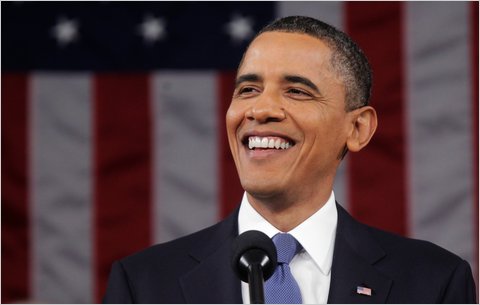
SOTU and Sputnik: Economic nationalism, political paralysis, and the decline of the American Empire


I haven't yet commented on last night's State of the Union address, nor on the Republican response, but, then, what more is there to say?

TNR's John Judis thinks it was President Obama's best speech as president. I do not agree, though I'm hard-pressed to name a better one. Not because I thought his SOTU was all that great but because he hasn't exactly given many memorable speeches as president.

Content-wise, I suppose a lot depends on what you think of Obama's economic nationalism, the core theme of last night's speech. The world is moving ahead and America is in decline. That decline is relative, as it is still on top, for the most part, but how long will it be before China and perhaps India take over?

In referencing Sputnik at the core of his speech, Obama was saying that America is now at a fork in the road, much as it was after the Soviet Union launched that first satellite into space. One road leads to further decline, one road leads to further superpowerdom:

Half a century ago, when the Soviets beat us into space with the launch of a satellite called Sputnik¸ we had no idea how we'd beat them to the moon. The science wasn't there yet. NASA didn't even exist. But after investing in better research and education, we didn't just surpass the Soviets; we unleashed a wave of innovation that created new industries and millions of new jobs.

This is our generation's Sputnik moment. Two years ago, I said that we needed to reach a level of research and development we haven't seen since the height of the Space Race. In a few weeks, I will be sending a budget to Congress that helps us meet that goal. We'll invest in biomedical research, information technology, and especially clean energy technology -- an investment that will strengthen our security, protect our planet, and create countless new jobs for our people.

I hardly count myself an economic nationalist, or a nationalist of any kind, and certainly not in American terms, but I do think that Obama is generally right about this. Private investment -- business -- is simply not enough. What is needed, as it was back in the '50s, is extensive government investment in everything from health care to education to research and development in next-generation technological innovation.

This is where conservatives get it wrong. No one is saying, let alone Obama, that business doesn't matter, or that government ought to replace business. We all acknowledge that businesses create jobs and for the most part keep the economy moving. But business, taken as a whole, simply does not have the big picture in mind. Business is about profit, about maximizing returns for shareholders. And that's fine. But sometimes you need, a society needs, government to step in and lead the way. Conservatives pretend that this is never the case, or perhaps have convinced themselves that government can never be the answer. This is historical revisionism, a failure to appreciate how American capitalism, and capitalism generally, has evolved over time.

As Slate's Fred Kaplan explains, huge government investment has been behind many of the most significant technological developments and innovations of recent decades, from space exploration (most notably JFK's pledge to go to the moon, ultimately realized less than a decade later) to the microchip to the Internet:

John Kennedy ran for president in 1960, promising a "new frontier" founded on "vigor." Early in his term, he directly responded to Sputnik in two ways: He poured money into the Minuteman ICBM program (both before and after he realized that the missile gap was a myth). And he pledged to land an American on the moon by the end of the decade.

In the spring of 1959, Texas Instruments had introduced a new technology called the microchip. But it was very expensive and generated no demand from the private sector. However, these tiny chips would be needed to power the guidance systems in the Minuteman's nose cone -- and in the coming Apollo program's space capsule.

It was the Pentagon and NASA that bought the first microchips. The demand allowed for economies of scale, driving down costs enough so that private companies started building products that relied on chips. This created further economies of scale. And so came the inventions of the pocket calculator, smaller and faster computers, and, decades later, just about everything that we use in daily life.

None of this was inevitable. It started only because of government investment. Obama made this same point in Tuesday night's address: "Our free enterprise is what drives innovation. But because it's not always profitable for companies to invest in basic research, throughout history our government has provided cutting-edge scientists and inventors with the support they need. That's what planted the seeds for the Internet. That's what helped make possible things like computer chips and GPS."

GPS was initially an Air Force program, designed to make bombs more accurate. The Internet was an internal communication program created by the Defense Advanced Research Projects Agency.

Obama could have gone back further. The first commercial computer, the IBM 1401 of the late 1950s, came about only because the first customers were government agencies, the Social Security program and the Veterans Administration, which required a computer with enough capacity to store data about the millions of Americans receiving government checks.

If conservatives like today's had had their way, none of this would have happened -- or, rather, it would have, but America likely would not have been the leader of the computer age, the American economy wouldn't have boomed as it did, and Americans, along with American businesses, wouldn't have reaped the benefits of such astonishing innovation.

Obama's speech was all about winning the future, as Slate's John Dickerson notes:

He described a challenge to the American dream: The promise of prosperity is threatened by technology and global competition. His pitch was aimed at those Americans "who feel like the rules have been changed in the middle of the game." After sketching this moment of uncertainty, he quickly moved to optimism, rallying the country to its strongest traditions of perseverance and affirming that Americans have always been able to shape their own destiny. His speech was practically a 12-step program for reconnecting the American people with the dream that animated the country at its beginning. 

There is a dark side to this, of course. Back in the '50s and '60s, there was a clear enemy, the Soviet Union, and Americans (and most westerners) rallied against it. But what is there now? According to Obama -- and he's right about this -- the real challenge to America (if not so much to the rest of the West) is not al Qaeda, or Islamism broadly, but emerging economic superpowers like China and India, and perhaps even Europe. A challenge is not necessarily the same as an enemy, but the risk is that the rest of the world will be seen now as the primary threat to America's future, if not to its survival then at least to its standing atop the world. And this would mean vilifying the Chinese and the Indians, among others. Nationalism, after all, isn't just about national pride and a focus on national interests but about exclusion, about "us" and "them." The world is getting smaller and smaller, but nationalism is about building walls, about driving people apart. Is that really the way to do?

Of course, many other governments invest heavily in domestic industry, and so, to an extent, the U.S. would (and should) be no different. So, fine. Go ahead and invest. The problem is, where is the investment going to come from? Beyond Obama's high-falutin' rhetoric, where is the political will for it happen?

Obama did not call for shared sacrifice but instead for bipartisanship. There's a huge difference. It was fairly easy, relatively speaking, to call for sacrifice when faced with the Soviet threat, but now? All President Bush told Americans to do after 9/11 was to go shopping. Obama still clings to the delusions of post-partisanship that characterized his campaign -- whether he actually believes such nonsense is not clear, but what else are we to take from his insistent rhetoric? -- and so merely asks Democrats and Republicans to work together to address the country's problems. He will do his part, as always, by reaching out across the aisle, but have we, has he, learned nothing of the first two years of his presidency. Republicans want no part of working with him or his party on anything. He might be able to peel off a Republican or two here and there, but the health-care debate is ample evidence that Republicans refuse to compromise in good faith.

And so, the merits of Obama's innovation-based approach aside, progress, it would seem to me, isn't likely. Dickerson notes that the president used the phrase "win the future," or a variant, 11 times in his speech. That means that the speech sounded very much like "a self-help seminar," one loaded with typically banal "tag lines from corporate marketing." Yes, he's for more government investment, perhaps akin to what happened in the '50s and '60s, but the message was presented at such a high level that it rang hollow. And as if that weren't enough, Obama indicated that he remains committed to the tax-cut, spending-cut fiscal conservatism of the political center. As Kaplan writes:

Obama proposed, starting this year, to "freeze annual domestic spending for the next five years," a step that, he boasted, would "bring discretionary spending to the lowest share of our economy since Dwight Eisenhower was president."

It's hard to see how he or the Congress can resolve this contradiction -- Kennedy-esque vigor and investment on the one hand, Ike-like torpor and penny-pinching on the other. He said much of this extra money could be freed up by eliminating subsidies for the oil companies. First, good luck on that. And second, that alone won't free up enough.

So where's the money going to come from? Even if he gets Democrats on board -- and he certainly won't get all of them -- there's no way Republicans are going to agree to massive government investment in anything, let alone when they mistakenly think voters gave them an anti-government mandate last year and when they plan on running along Tea Party lines in 2012.

Sure, this was the "old" Obama again, the one calling for the "hard choices" to be made and for bipartisanship to prevail, and he was generally quite effective, and, sure, Americans seem to like what they heard, but where exactly do we go from here? It sounded more like Obama was laying the groundwork for his re-election bid, presenting a nationalistic (and vaguely populistic) vision that appeals to independents, then he was presenting anything resembling a realistic policy agenda for the next two years. (As TNR's Jonathan Chait remarks, the president's "emphasis on public investment reflects less a desire to increase spending on infrastructure, R&D and the like than a platform from which to oppose anticipated Republican cuts.")

That's fine, I suppose -- he needs to run on something, after all -- but it just seems to confirm that nothing is actually going to happen. Even if Americans like what they heard, they don't want their taxes raised and they have a party, the GOP, that is fundamentally anti-tax and anti-government and that will appeal to them along those lines. Americans also oppose cuts to most government programs, including Social Security, of course, even if Republicans refuse to acknowledge this, and so as the country faces political intractability, and as the willingness to accept shared sacrifice is largely non-existent, there just isn't the money for what Obama wants.

Even if this is another Sputnik moment for America, the outcome will be very different. Obama will make his case, Republicans will make theirs, and nothing will change -- except, from time to time, the politicians voters send to Washington.

The decline of the American Empire, already in full swing, continues.