Showing posts with label government spending. Show all posts

Wednesday, August 3, 2011

Plain speaking: What President Obama should have said to the American people about the budget and the debt ceiling


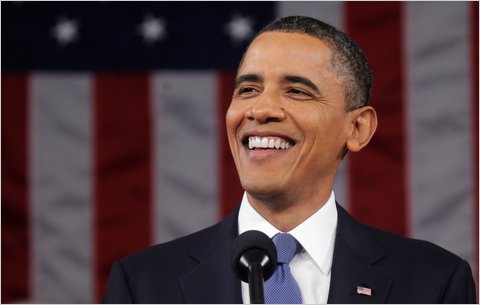
This is the speech Obama should have given on Sunday night -- before he let the terrorists Republicans dance the hora all night. His polls would have gone up at least 20 points and his re-election would have been all but guaranteed. Americans may love hearing the words "tax cuts" (even when they're for 1% of the population), but they love their John Wayne character even more.

Ladies and gentlemen, the President of the United States:

Good evening.

As we all know, the U.S. government is scheduled to reach its limit for borrowing, or what has come to be known as the "debt ceiling" on Tuesday. The U.S. Congress, knowing full well the consequence of not increasing that limit would be economic chaos, has historically raised the ceiling under both Republican and Democratic administrations. This time, due to the intransigence of the opposition Republicans in the House, Congress has been unable to reach a compromise that would increase that limit. With a painful and catastrophic default staring us in the face, I am ordering the following steps to be taken:

Unless a clean bill raising the debt ceiling reaches my desk by Monday night, I will invoke the clause in the 14th Amendment to the Constitution that states, "The validity of the public debt of the United States, authorized by law, including debts incurred for payment of pensions and bounties for services in suppressing insurrection or rebellion, shall not be questioned" -- to raise the debt ceiling. As President of the United States, I cannot morally or financially let the United States default on its obligations. I cannot allow the actions of a small group of Representatives to push the entire American economy off a cliff. I cannot allow millions to suffer at the hands of a few. If you do not agree with this process or do not take well to the move I am undertaking and want to begin some sort of investigation into the legality of this procedure or even impose hearings for impeachment, let me quote our last Presiden: "Bring it on." I look forward to that fight.

After we ensure the continued flow of checks and payments, Congress and the Executive Branch will immediately begin discussion of the U.S. budget. To be blunt, these budget discussions will include spending cuts across the board, including defense, subsidies to the wildly profitable industries, and closing loopholes that exist only to enhance the re-election of specific Senators and Representatives, for example the corporate jet loophole. I cannot say what the figure will be, but every branch of government will be touched, including many of the perks enjoyed by Members of Congress.

The budget discussions will also include raising taxes on individuals and on corporations, especially those persons that make over $250,000 and corporations that have generated enormous profits yet pay minimal to nothing in taxes. Many of these individuals and corporations have profited greatly from the tax breaks and government bailouts over the past decade. It is time to review just exactly what this government largesse has truly cost a majority of the American people. The Bush tax cuts, which have cost over $400 billion and have not created any jobs, will not be renewed in their current form -- period.

These budget discussions will also include an in-depth examination of the cost to the American economy of sending jobs abroad and the creation of a public works program in conjunction with the private sector to rebuild our faltering infrastructure. The U.S. cannot compete in a world where jobs are shipped out of the country to save a few dollars and the rest of the world builds while applying band aid after band aid.

In addition, I am ordering Harry Reid and John Boehner to keep their respective constituents in session all month -- yes, I know it is August -- to hammer out the framework of a budget that I can sign, a budget that will truly demonstrate shared sacrifice across the board, a sacrifice that will not be based solely on those who cannot pay for high-priced lobbyists sent to D.C. to protect specific breaks and grants.

The past three years have not been a vacation for the American people, and therefore we, the men and women who these struggling Americans elected to shepherd in a better and stronger America, are not taking a vacation until we can agree on a true compromise to get our fiscal house in order.

Thank you.

Sunday, July 31, 2011

On vacation, full of debt ceiling rage


I'm currently on vacation and won't be blogging all that much over the next few weeks. Here and there, when the mood is right, but otherwise not. Rest, relaxation, and family are the priorities.

But, fear not, Richard and the gang will keep things rolling, and so I hope you keep checking back for new posts from my wonderful team.

Actually, though, I'm full of rage at the moment. I'm generally trying to avoid the news, and especially U.S. politics, but, well...

What has me enraged? The Deal, of course.

Yes, the new bipartisan deal to avert default by raising the debt ceiling and, to please Republicans, slash spending (of course, mostly spending that benefits the poor and downtrodden, the usual GOP targets, those no one in power seems to give a shit about).

Now, it's not yet a done deal. President Obama and the Democratic and Republican leadership have agreed to it, but not the rank and file -- and there are sure to be many on both sides who object to it.

Democrats have good reason to object. The deal is heavily Republican, a largely right-wing fix to a crisis created by Republicans. It's all about cuts, not revenue increases, and cuts that, again, will hurt those Democrats supposedly care about. Some Republicans will object as well, but only because -- let's put it kindly -- they're a bunch of petulant extremists who refuse to compromise and who are willing to let the country go into default, and face economic calamity, to get everything they want.

In fact, it has come to this largely because Republicans, from the top down (the leadership included), are bullies crazy enough to risk the country's health, so "patriotic" are they, having basically held the country hostage throughout this entire process.

Sure, I'm deeply critical of Democrats, including the president, for not fighting harder to prevent this, and for not standing up more determinedly for what they purportedly stand for, but, honestly, what were they supposed to do? Let the country go into default? Let the debt ceiling deadline pass, come what may? Sure, maybe. Maybe they could have spun that and kept the blame on the other side, and even come away with a political win, and maybe the impending crisis and public outcry would have forced Republicans back to the negotiating table with their tails somewhat between their legs, but... should they really have taken such an enormous risk?

Maybe Republicans were always going to win this, maybe it was inevitable, because all along they were willing to go further and risk more. That's the problem trying to negotiate with crazy people. They're willing to do things you're not. (Isn't that how Keyser Söze solidified his power?) In this case, Republicans were willing to sacrifice their country for their ideological demands. Democrats, being mature and rational and responsible, were not. And so they had to agree to a deal on Republican (i.e., insane) terms.

There was a brief time when Obama had the upper hand, after he had turned the tables on Republicans and back them into a corner, and with public opinion on his side, but he was only going to win this if he went all the way. And, say what you will about him, he wasn't prepared to play that game, not with so much at stake.

I suspect the deal will pass tomorrow. There will be major defections, but surely enough arms can be twisted, enough dissenters bought off, to make it happen.

And then? Crisis will have been averted, at least temporarily, but Republicans will declare victory -- for getting most of they want (loads of cuts, no new revenue).

The Democrats? They'll get nothing out of this politically.

Obama? Yes, probably. He'll be able to reinforce his credibility among independents by presenting himself as a bipartisan leader who got it done when it mattered (no matter the awful details of what got done).

But unless Democrats can gain control of the narrative and make the debate about ending the deeply unpopular Bush tax cuts for the wealthy and protecting deeply popular entitlement programs (Social Security, Medicare, etc.), this deal won't do them any political favors next year, with with Republicans set to hammer them, however dishonestly (as usual), for being tax-happy, spend-happy socialists.

At least for now, there is reason for cautious, extremely cautious optimism. The deal would allow the president to raise the debt ceiling by $2.4 trillion (with $900 billion in spending cuts):

That will be paired with the formation of a Congressional committee tasked with reducing deficits by a minimum of $1.2 trillion. That reduction can come from spending cuts, tax increases or a mixture thereof.

If the committee fails to reach $1.2 trillion, it will trigger an automatic across the board spending cut, half from domestic spending, half from defense spending, of $1.2 trillion. The domestic cuts come from Medicare providers, but Medicaid and Social Security would be exempted. The enforcement mechanism carves out programs that help the poor and veterans as well.

If the committee finds $1.5 trillion or more in savings, the enforcement mechanism would not be triggered. That's because Republicans are insisting on a dollar-for-dollar match between deficit reduction and new borrowing authority, and $900 billion plus $1.5 trillion add up to $2.4 trillion.

However, if the committee finds somewhere between $1.2 and $1.5 trillion in savings, the balance will be made up by the corresponding percentage of the enforcement mechanism's cuts, still in a one-to-one ratio.

Democrats say they're confident that the enforcement mechanism is robust enough to convince Democrats and Republicans to deal fairly on the committee -- to come up with a somewhat balanced package of entitlement reforms and tax increases. However, the White House assures them that if the committee fails to produce "tax reform" he will veto any attempt to extend the Bush tax cuts, which expire at the end of next year.

Again, the focus is on spending cuts, not revenue increases, but at least cuts to defence spending are on the table and at least it's possible that revenue increases will be part of any future deal.

Actually, scratch that. I'm still highly enraged. And there's really no good reason for optimism at all, even cautious optimism. Obama may want to use the Bush tax cuts for the wealthy in his re-election campaign, as a winning issue (assuming public opinion stays roughly where it is), but he has shown little to no willingness to stand up for progressive principles -- indeed, for principles that are simply not Republican, so much of a moderate Republican does he appear to be -- and, what's more, neither have most Democrats on Capitol Hill, it seems.

All of which is to say, if Obama and the Democrats have been willing to cave so much already, what should make us think anything will change?

Wednesday, July 13, 2011

Obama is full of shit


(Ed. note: For more on the politics of the debt ceiling debate, not that there's any real debate, see my post from yesterday, "Why the hell is Obama willing to give away so much just to get a debt ceiling deal done?" -- MJWS)
I don't think President Obama is a dick, but I do think he's full of shit – and I mean that in a the most adoring and respectful way possible.

The Huffington Post reports that House Speaker John Boehner gave an emphatic "NO!" to President Obama's proposal to cut Medicare and Social Security spending if Republicans agree to $100 billion in annual tax increases as part of the debt ceiling negotiations: 

Boehner is rejecting President Obama's offer to make historic cuts to the federal government and the social safety net, saying in a statement Saturday evening that he can not agree to the tax increases Democrats insisted on as part of the bargain. 

Unless Obama recently was lobotomized, this is just politics.

Putting "entitlements" on the table merely adds to the image of the president as a moderate negotiator, a sane, bipartisan national leader who's willing and ready to attack the big problems of the country by reaching across the aisle and making the unpopular decisions no president or Congress has been willing to make for decades.

He may want to appear as that guy, and he is appearing as that guy, but he's not actually trying to be guy – mainly because that guy would be an idiot.

Obama saw the incensed response from the electorate when House Republicans voted on a budget plan that essentially privatized Medicare. Members of Congress were being booed out of town-hall meetings by 90-year olds, for Christ's sake. The reaction wouldn't have been any different if Democrats had proposed it. And that is why I don't think Obama's "Grand Bargain" was made in good faith.

It was political posturing, pure and simple. Obama needed no contingency plan because he knew Boehner couldn't afford the political blowback within his party of accepting such a deal – not with the Norquistian Tea Partiers equating tax increases with treason. Republicans would have been slaughtered just as savagely by their constituents as Democrats would have been by theirs.

As Jay Newton-Small put it:

[T]the collapse of the grand bargain leaves President Obama in a more favorable political position. If both parties agree to cut $2 trillion from the budget with minor tax increases, he'll notch a bipartisan accomplishment. But he can also say he tried something more ambitious in putting cuts to Social Security and Medicare on the table without facing the political fallout of actually slashing those programs. He went big and congressional Republicans – not to mention the noticeably silent 2012 Republican presidential candidates – didn't.

Well said.

Obama isn't a dick. He’s a political genius.

(Cross-posted at Muddy Politics.)

Government shutdown 2.0: The debt ceiling

By Nicholas Wilbur 

It's getting down to the wire. The eleventh hour. Crunch time.

If Democrats and Republicans don't make a deal on the debt ceiling by August 2, the Earth will explode. The U.S. will default on its debts. Interest rates will rise. Rep. Eric Cantor will make a killing on his stock investments against the U.S. economy. And who knows, Ann Coulter might not look like a barfly in her next book-jacket photo, Jon Stewart might sign a contract with Fox News, Rep. Barney Frank might go back into the closet, and Marcus Bachmann might come out.

Golfing Buddies: Obama & Boehner
Source: Charles Dharapak/Associated Press

Nobody knows for sure how bad it would be if America defaulted, but everyone who's trained in the economic arts to have an educated opinion about such things seems pretty well convinced it wouldn't rank very far behind "vicious shark attack" on the summer fun scale. And isn't that odd? Doesn't President Obama have an apocalypse czar for this sort of thing?

The fact that nobody knows the exact consequences of a default says something about the likelihood of Congress not increasing the debt ceiling. Maybe it's just me, but this seems oddly reminiscent of the media frenzy surrounding the government shutdown threats in March and April of this year, when Republicans demanded a "historic" $100 billion in spending cuts to the 2011 budget.

Remember that? All the hype about the effects a shutdown would have on society – the unsettling mental images of senior citizens rotting in their own filth because they didn't get their Social Security checks on time to pay the nurse, little kids burning American flags in protest of Yellowstone campground closures, foreigners rioting in the streets (of their home countries?) because their VISA applications weren't processed? It was going to be chaotic. And then, suddenly, it wasn't.

It didn't happen. The Republicans who'd threatened to shut down the government if Obama and Co. didn't defund Planned Parenthood and NPR and the health-care reform law and the EPA, they eventually compromised, threw in the towel on the Tea Party's demands for radical policy riders, and settled on a budget deal that satisfied everyone, more or less.

Leaders from both parties boasted about the agreement, the shared sacrifice, "the biggest annual spending cut in history."

Facing threats of a primary election challenge from the Tea Party, House Speaker John Boehner (R-Ohio) had to confute his right-wing critics who claimed he was a spineless "Republican in Name Only" (RINO). And he did. He secured "historic" budget cuts and proved himself a socialism slayer, a fiscal hawk, and a trusted advocate of the small government ideal that is foundational to the Republican Party.

"This has been a long discussion and a long fight," he said, "but we fought to keep government spending down because it really will, in fact, help create a better environment for job creators in our country." The "fact" about a better job creating environment didn't pan out exactly as planned, but he heralded the deal as a victory for the GOP, because it was, and he promised to continue fighting for even more spending cuts in the future, which he has.

President Obama got what he needed from the deal as well. He was the lead negotiator of a compromise bill that was both fiscally and socially responsible. "Reducing spending while still investing in the future is just common sense," he said. He demonstrated his leadership skills by negotiating what amounted to a short-term stimulus bill, and he upheld his promise to govern from the middle – an appeal to both independent voters and the moderates who comprise the majority of the Democratic establishment. Once again, he looked like the adult sitting at the kids table. 

They avoided a government shutdown, and something tells me Congress won't let the country fall into default, either, if only because nothing has changed since the April budget deal.

Raising the debt ceiling isn't uncommon, not since Reagan anyway.
Source: TheAtlantic.com

The same Tea Party leaders continue to threaten RINOs with primary-election challenges. The same Democratic president continues his pursuit to convince the nation that he's not the radical left-wing socialist Fox & Friends accuse him of being. And the same anti-Washington blowback is at stake if the two parties fail to reach an agreement.

Will there be significant spending cuts? Probably, at least compared to what Republicans managed to finagle from Obama last time around. (The non-partisan Congressional Budget Office reported after the budget agreement was approved that the $78 billion in alleged spending cuts actually resulted in a net increase in government spending – to the tune of about $3.2 billion.)

Will the country crumble under the pressure of such austerity measures? Probably not, as Obama and the leaders of the Democratic Party understand much better than I do that appearing as the sane and level-headed party of political moderates means nothing in the eyes of the electorate if the spending cuts they so pragmatically negotiated end up causing a double-dip recession.

As Andrew Leonard predicted, the final product will likely involve "loophole closing, public-sector-employee squeezing, inflation-index finagling, and tax code juggling that allows Democrats to claim revenue increases while Republicans can pledge allegiance to the god of zero tax hikes."

But at the end of the day, the details of an agreement matter less than the politics of it. Boehner and the GOP need only look like hawks in the eyes of the extremists and the 67 percent of Republicans who identify as "conservatives." Obama and the Democrats need only appear as moderate and responsible peacekeepers who saved America from an economic apocalypse without giving away the farm in the process.

When each side agrees to the talking points, they will emerge from the negotiations and begin a joint press conference announcing in broad strokes the "historic" agreement to increase the debt ceiling before the August 2 deadline.

Because that's politics.

(Cross-posted at Muddy Politics.)

Sunday, February 6, 2011

How the GOP is a party of words: Promises are promises are promises...


Transitions are always difficult. If you're a Republican, Change® is particularly tough to swallow – which is why the GOP spent the last two years projectile vomiting on anything that tasted like "Progress" and throwing filibuster tantrums whenever Congress debated a bill on Capitol Hill.

They swept the midterm elections, nonetheless, not with a strong record – or any record at all – but by riding the coattails of the anti-government prattle of the Tea Party patriots who flooded the mainstream media with sensational circus theatrics and apocalyptic prophesies of the country's imminent demise were Democrats to remain in power.

The seemingly sane but obviously stubborn Republicans teamed up with Tea Party candidates and capitalized on the nation's fears and doubts by crafting a national message so bold it could not be ignored, even by liberals, who, for good or ill, were transfixed. Traditional Republicans, as the media has since dubbed the non-Tea Partiers, touted a "repeal and replace" strategy to undo the alleged devastation wrought by the Obama Administration and his Democratic Party minions in Congress. The Teabaggers, as the left-wing media dubbed the ideological extremists, did their part by peppering the rhetoric with threats to amend the Constitution and deny citizenship to brown people, abolish the IRS, and defund the departments of interior, commerce and education that these Fox News junkies believed had become a black hole for taxpayer dollars. 


But Republicans knew they couldn't continue riding in the back of the leadership bus through 2011. With majority control of the lower branch of Congress, there was a sudden expectation that these new leaders would actually lead, that these new lawmakers would actually make laws. Bitching and whining and obstructing the legislative process at every turn would not suffice with majority status in "the people's house" of Congress. 

They had to appear, at least on the surface, that they were worthy of the government paychecks they received.

And so, after a year-long campaign focused on accusing Democrats of ignoring the main concern of the American people – job creation – Republicans got right down to business upon entering office. Sort of. 

They amended the House rules to require that all bills brought to the floor include a constitutional citation of lawfulness. They rescinded the already limited voting rights of delegates from D.C., Puerto Rico, American Samoa, and elsewhere. They required that all bills include spending cuts to offset any costs needed for implementation of the newly-proposed legislation (exempting, of course, tax cuts for the rich and their repeal of President Obama's health-care law). And they changed the House schedule to give every lawmaker one week off for every two weeks worked. 

That was just the beginning. 

As they settled into their new positions of power, Republicans showed their dedication to the financially strapped American working class by introducing... a bill to remove the polar bear from the endangered species list, a bill to abolish the IRS and eliminate the income tax, and another bill that would redefine rape. 

Having promised to cut $100 billion from the federal budget this fiscal year, Republicans drafted legislation to free up a whopping $61 million (yes, million) in the budget by abolishing public financing for presidential elections. Most recently, they voted on what amounts to an office memo, a skeletal outline, a very rough, very unspecific, and very ambiguous House Resolution that calls for $32 billion in cuts.

Not exactly landmark legislation. Not legislation at all, in most cases. In fact, the only significant piece of legislation proposed thus far by Republicans has been the health-care repeal bill, which, given its chances of becoming law, wasn't much of a bill at all. They spent the last year promising to "repeal and replace" the 2,000-plus-page law known by conservatives as "ObamaCare," but the "replace" portion of the promise was conveniently absent from the two-paragraph repeal bill passed in the House. As they knew it would, this faux legislation failed in the Senate.

So here we are one month into the new Congress, with Republicans still reeling from a landslide victory over Democrats in the midterm election, and what do we have to show for it? 

Nothing. 

And looking back, we should not be surprised. We all saw this coming. 

After "shellacking" Democrats in the midterm elections, Republicans returned to Washington intent on "saving millions of taxpayer dollars." They began this quest by attempting to eliminate grant funding for public radio. The $3.2 million in projected annual savings was pittance, they knew, and doomed to failure, as they eventually saw. But they tooted their horns and banged their drums nonetheless, eventually blaming liberals for offering government handouts to Not Pro Republican media outlets. Next in line: banning earmarks, another pittance estimated to save $16 billion a year. That fell flat when Republicans realized that banning earmarks meant they could no longer fund infrastructure projects in their home states. There were also targeted efforts to deny unemployment benefits, thwart the judicial "interference" in cases where employees are raped on the job, and kill a bill to award health care to 9/11 first responders. 

The last two months of the 111th Congress saw more of the same blind Republican opposition that had defined their presence in Washington, really, since Democrats won the majority in 2006. In the final days of 2010, Republicans followed up their backward opposition to the DREAM Act and the repeal of "Don't Ask, Don't Tell" by fighting vigorously against even the no-brainer nuclear arms treaty with Russia, New START. 

They railed against excessive government spending (without acknowledging their role in the unpaid-for prescription drug program, the Bush tax cuts, and the two wars that created a $1.3 trillion deficit by the end of Bush's second term), but then balked when it came time to identify specific spending cuts. Perhaps in their most egregious display of hypocrisy, Republicans threatened to shut down the government if President Obama and the Democrats didn't get on board with the GOP priority of extending Bush's tax cuts for another two years. 

It worked. The rich kept their disproportionate tax breaks, but the result didn't quite live up to the Republican Party's pledge to cut spending back to 2008 levels, as outlined in their "Pledge to America" campaign manifesto. Conversely, it cost about $100 billion more than the 2009 economic stimulus bill they so loathed. 

The empty promises, the lofty and impractical goals, the "repeal and replace" agenda that has thus far come up empty on both fronts – these have all proven mere strategies in a shell game of hallow rhetoric meant to brainwash taxpayers into thinking that their new leaders in Washington are well-deserving of the $174,000 (plus health care benefits) that we pay them for representing We the People.

The naysayers and witch hunters of anything smelling of liberalism have demonstrated that they are not patriots defending against Socialism as much as they are stalwart defenders of the Bush-era status quo. The people loved them for it throughout the last congressional session, they praised them for it throughout the campaign season, and they turned out in swaths to reward them for it at the ballot box on Nov. 2, 2010. Now a month into the 112th Congress, Republicans are enjoying their highest popularity rating in years.

Republicans interpreted the last election as a mandate against the progressive agenda. Voters, they said, showed unequivocally that they wanted whatever was the opposite of progress and change. 

This is about as close as it gets.


(Cross-posted at Muddy Politics.) 

***********

Background photo of John Boehner from National Journal.

Republican favorable/unfavorable chart from Gallup.

Wednesday, January 26, 2011

SOTU and Sputnik: Economic nationalism, political paralysis, and the decline of the American Empire


I haven't yet commented on last night's State of the Union address, nor on the Republican response, but, then, what more is there to say?

TNR's John Judis thinks it was President Obama's best speech as president. I do not agree, though I'm hard-pressed to name a better one. Not because I thought his SOTU was all that great but because he hasn't exactly given many memorable speeches as president.

Content-wise, I suppose a lot depends on what you think of Obama's economic nationalism, the core theme of last night's speech. The world is moving ahead and America is in decline. That decline is relative, as it is still on top, for the most part, but how long will it be before China and perhaps India take over?

In referencing Sputnik at the core of his speech, Obama was saying that America is now at a fork in the road, much as it was after the Soviet Union launched that first satellite into space. One road leads to further decline, one road leads to further superpowerdom:

Half a century ago, when the Soviets beat us into space with the launch of a satellite called Sputnik¸ we had no idea how we'd beat them to the moon. The science wasn't there yet. NASA didn't even exist. But after investing in better research and education, we didn't just surpass the Soviets; we unleashed a wave of innovation that created new industries and millions of new jobs.

This is our generation's Sputnik moment. Two years ago, I said that we needed to reach a level of research and development we haven't seen since the height of the Space Race. In a few weeks, I will be sending a budget to Congress that helps us meet that goal. We'll invest in biomedical research, information technology, and especially clean energy technology -- an investment that will strengthen our security, protect our planet, and create countless new jobs for our people.

I hardly count myself an economic nationalist, or a nationalist of any kind, and certainly not in American terms, but I do think that Obama is generally right about this. Private investment -- business -- is simply not enough. What is needed, as it was back in the '50s, is extensive government investment in everything from health care to education to research and development in next-generation technological innovation.

This is where conservatives get it wrong. No one is saying, let alone Obama, that business doesn't matter, or that government ought to replace business. We all acknowledge that businesses create jobs and for the most part keep the economy moving. But business, taken as a whole, simply does not have the big picture in mind. Business is about profit, about maximizing returns for shareholders. And that's fine. But sometimes you need, a society needs, government to step in and lead the way. Conservatives pretend that this is never the case, or perhaps have convinced themselves that government can never be the answer. This is historical revisionism, a failure to appreciate how American capitalism, and capitalism generally, has evolved over time.

As Slate's Fred Kaplan explains, huge government investment has been behind many of the most significant technological developments and innovations of recent decades, from space exploration (most notably JFK's pledge to go to the moon, ultimately realized less than a decade later) to the microchip to the Internet:

John Kennedy ran for president in 1960, promising a "new frontier" founded on "vigor." Early in his term, he directly responded to Sputnik in two ways: He poured money into the Minuteman ICBM program (both before and after he realized that the missile gap was a myth). And he pledged to land an American on the moon by the end of the decade.

In the spring of 1959, Texas Instruments had introduced a new technology called the microchip. But it was very expensive and generated no demand from the private sector. However, these tiny chips would be needed to power the guidance systems in the Minuteman's nose cone -- and in the coming Apollo program's space capsule.

It was the Pentagon and NASA that bought the first microchips. The demand allowed for economies of scale, driving down costs enough so that private companies started building products that relied on chips. This created further economies of scale. And so came the inventions of the pocket calculator, smaller and faster computers, and, decades later, just about everything that we use in daily life.

None of this was inevitable. It started only because of government investment. Obama made this same point in Tuesday night's address: "Our free enterprise is what drives innovation. But because it's not always profitable for companies to invest in basic research, throughout history our government has provided cutting-edge scientists and inventors with the support they need. That's what planted the seeds for the Internet. That's what helped make possible things like computer chips and GPS."

GPS was initially an Air Force program, designed to make bombs more accurate. The Internet was an internal communication program created by the Defense Advanced Research Projects Agency.

Obama could have gone back further. The first commercial computer, the IBM 1401 of the late 1950s, came about only because the first customers were government agencies, the Social Security program and the Veterans Administration, which required a computer with enough capacity to store data about the millions of Americans receiving government checks.

If conservatives like today's had had their way, none of this would have happened -- or, rather, it would have, but America likely would not have been the leader of the computer age, the American economy wouldn't have boomed as it did, and Americans, along with American businesses, wouldn't have reaped the benefits of such astonishing innovation.

Obama's speech was all about winning the future, as Slate's John Dickerson notes:

He described a challenge to the American dream: The promise of prosperity is threatened by technology and global competition. His pitch was aimed at those Americans "who feel like the rules have been changed in the middle of the game." After sketching this moment of uncertainty, he quickly moved to optimism, rallying the country to its strongest traditions of perseverance and affirming that Americans have always been able to shape their own destiny. His speech was practically a 12-step program for reconnecting the American people with the dream that animated the country at its beginning. 

There is a dark side to this, of course. Back in the '50s and '60s, there was a clear enemy, the Soviet Union, and Americans (and most westerners) rallied against it. But what is there now? According to Obama -- and he's right about this -- the real challenge to America (if not so much to the rest of the West) is not al Qaeda, or Islamism broadly, but emerging economic superpowers like China and India, and perhaps even Europe. A challenge is not necessarily the same as an enemy, but the risk is that the rest of the world will be seen now as the primary threat to America's future, if not to its survival then at least to its standing atop the world. And this would mean vilifying the Chinese and the Indians, among others. Nationalism, after all, isn't just about national pride and a focus on national interests but about exclusion, about "us" and "them." The world is getting smaller and smaller, but nationalism is about building walls, about driving people apart. Is that really the way to do?

Of course, many other governments invest heavily in domestic industry, and so, to an extent, the U.S. would (and should) be no different. So, fine. Go ahead and invest. The problem is, where is the investment going to come from? Beyond Obama's high-falutin' rhetoric, where is the political will for it happen?

Obama did not call for shared sacrifice but instead for bipartisanship. There's a huge difference. It was fairly easy, relatively speaking, to call for sacrifice when faced with the Soviet threat, but now? All President Bush told Americans to do after 9/11 was to go shopping. Obama still clings to the delusions of post-partisanship that characterized his campaign -- whether he actually believes such nonsense is not clear, but what else are we to take from his insistent rhetoric? -- and so merely asks Democrats and Republicans to work together to address the country's problems. He will do his part, as always, by reaching out across the aisle, but have we, has he, learned nothing of the first two years of his presidency. Republicans want no part of working with him or his party on anything. He might be able to peel off a Republican or two here and there, but the health-care debate is ample evidence that Republicans refuse to compromise in good faith.

And so, the merits of Obama's innovation-based approach aside, progress, it would seem to me, isn't likely. Dickerson notes that the president used the phrase "win the future," or a variant, 11 times in his speech. That means that the speech sounded very much like "a self-help seminar," one loaded with typically banal "tag lines from corporate marketing." Yes, he's for more government investment, perhaps akin to what happened in the '50s and '60s, but the message was presented at such a high level that it rang hollow. And as if that weren't enough, Obama indicated that he remains committed to the tax-cut, spending-cut fiscal conservatism of the political center. As Kaplan writes:

Obama proposed, starting this year, to "freeze annual domestic spending for the next five years," a step that, he boasted, would "bring discretionary spending to the lowest share of our economy since Dwight Eisenhower was president."

It's hard to see how he or the Congress can resolve this contradiction -- Kennedy-esque vigor and investment on the one hand, Ike-like torpor and penny-pinching on the other. He said much of this extra money could be freed up by eliminating subsidies for the oil companies. First, good luck on that. And second, that alone won't free up enough.

So where's the money going to come from? Even if he gets Democrats on board -- and he certainly won't get all of them -- there's no way Republicans are going to agree to massive government investment in anything, let alone when they mistakenly think voters gave them an anti-government mandate last year and when they plan on running along Tea Party lines in 2012.

Sure, this was the "old" Obama again, the one calling for the "hard choices" to be made and for bipartisanship to prevail, and he was generally quite effective, and, sure, Americans seem to like what they heard, but where exactly do we go from here? It sounded more like Obama was laying the groundwork for his re-election bid, presenting a nationalistic (and vaguely populistic) vision that appeals to independents, then he was presenting anything resembling a realistic policy agenda for the next two years. (As TNR's Jonathan Chait remarks, the president's "emphasis on public investment reflects less a desire to increase spending on infrastructure, R&D and the like than a platform from which to oppose anticipated Republican cuts.")

That's fine, I suppose -- he needs to run on something, after all -- but it just seems to confirm that nothing is actually going to happen. Even if Americans like what they heard, they don't want their taxes raised and they have a party, the GOP, that is fundamentally anti-tax and anti-government and that will appeal to them along those lines. Americans also oppose cuts to most government programs, including Social Security, of course, even if Republicans refuse to acknowledge this, and so as the country faces political intractability, and as the willingness to accept shared sacrifice is largely non-existent, there just isn't the money for what Obama wants.

Even if this is another Sputnik moment for America, the outcome will be very different. Obama will make his case, Republicans will make theirs, and nothing will change -- except, from time to time, the politicians voters send to Washington.

The decline of the American Empire, already in full swing, continues.


Monday, January 3, 2011

Cuomo targets government employees, will call for pay freeze


As the Times is reporting, new New York Gov. Andrew Cuomo is targeting government employees as part of a broader program of fiscal tightening:

ALBANY — Gov. Andrew M. Cuomo will seek a one-year salary freeze for state workers as part of an emergency financial plan he will lay out in his State of the State address on Wednesday, senior administration officials said.

The move will signal the opening of what is expected to be a grueling fight between the new governor and the public-sector unions that have traditionally dominated the state's political establishment.

It will also come days after the New Year's Eve layoffs of more than 900 state workers, an event that union representatives marked with a candlelight vigil on the steps of the Capitol and outside government offices in five other cities.

"The governor said during his campaign that the difficult financial times call for shared sacrifice," said a senior administration official, who requested anonymity because he was not authorized to speak publicly about the governor's address. "A salary freeze is obviously a difficult thing for many government workers, but it's necessary if the state is going to live within its means."

I have very much the same response to this as I had to President Obama's targeting of federal employees. It's a stupid and cynically symbolic move: Big headlines, minimal actual impact on the actual budget. As I put it at the end of November:

Of course, government is an easy target. People generally want government to do what they want -- and to be there when they need something (you know, like disaster relief or police protection) -- but don't want to pay for it.

And while even in this time of economic crisis companies are making huge profits and CEO are taking home huge salaries and bonuses, government employees can easily be scapegoated as the problem, or at least as a large part of the problem, even if they aren't.

It's not about reality, it's about public perception -- and conservatives have managed to convince much of the public that government employees are all a bunch of overpaid layabouts with their snouts in the public trough.

To be fair to Cuomo, things appear to be a bit more challenging at the state level, particularly in New York, where there isn't a bloated military budget that could be significantly pared down and where there aren't tax cuts for the wealthy that ought to be repealed. 

But what I also objected to was Obama's language. He talked back then about how "getting this deficit under control is going to require some broad sacrifice and that sacrifice must be shared by employees of the federal government." Fair enough, but who else is being asked to sacrifice other than those who are already having so much difficulty dealing with the ongoing economic situation? It is likely that any deal with Republicans over the deficit will require cuts to Social Security, and of course Republicans federally have blocked various efforts to extend unemployment and other benefits to those who need help the most. So the rich get their ridiculous tax cuts for another two years while the poor struggle even to put food on the table. And government employees (while, admittedly, not poor) face a pay freeze while Wall Street execs, bailed out by the government, end up with bonuses as massive as ever and corporate America piles on the profits while refusing to hire.

Where exactly is the shared sacrifice?

Look, I get it. Obama and Cuomo have to appear to be doing something about their respective deficits and, as government executives, they're in a position to target government employees, not Wall Street bigwigs and corporate bloodsuckers. And I'm not saying that government should regulate the pay of the private sector -- yes, I'm still a capitalist.

But stop it with the "shared sacrifice" nonsense. We all know who's being asked to sacrifice -- or, rather, who's being forced to sacrifice -- and who isn't.

And we all know that what Cuomo is doing, like what Obama is doing, is almost purely symbolic. As the Times notes, "the immediate budget savings from the freeze would be relatively modest -- between $200 million and $400 million against a projected deficit in excess of $9 billion -- achieving it would be politically meaningful." It's a way around the Assembly, a way around his own state Democratic Party, and a way around the public-sector unions -- a way to look aggressive and non-partisan. The good thing is that any freeze would have to be collectively bargained, and the unions should demand a good deal in return should they agree to it. (A good thing, too, is that a freeze would likely just be for one year -- so it's possible that a fair deal could be reached.)

And remember, the pay that government employees don't get is money that won't be spent, that won't help stimulate the economy at a time when economic stimulation, far more than fiscal restraint, is most needed to get the economy moving again.
I understand the need for all of us -- individuals, corporations, and governments alike -- to live within our means. It is deeply irresponsible, not to mention deeply unfair to future generations, for governments to rack up massive debt. And, yes, tough choices need to be made. But now is not the time for tightening before all else, for restraint over stimulation, for stupid, cynical moves that target the public sector, moves dressed up in the high-falutin', hypocritical, and simply dishonest rhetoric of shared sacrifice.

I have high hopes for Gov. Cuomo and for the most part I'm willing to give him the benefit of the doubt. We'll have to wait for Cuomo's State of the State address on Wednesday for the details of the plan, but I'm just not sure targeting government employees at this time of economic uncertainty and widespread despair is really the way to go.

Wednesday, December 29, 2010

The apocalyptic pain of starving the beast

Guest post by Nicholas Wilbur 

Nicholas Wilbur is an award-winning reporter and opinion columnist turned political junkie and critic. He is the founder of the blog Muddy Politics and lives in New Mexico.

(Ed. note: This is Nicholas's fifth guest post for us. You can find his first two, both on the Obama-GOP tax deal, here and here. You can find his third, on the potential for revolution, here, and his fourth, on the state of American democracy, here. -- MJWS)

********** 

When you starve the beast, the last think you expect is "apocalyptic pain," especially when the former strategy and the latter warning come from the same political party.

After two years of vigorously opposing and consistently filibustering any Democratic-proposed initiatives that were not paid for – and even many that were – Republicans executed a flawless about-face this month by then lobbying the White House to add more than $675 billion to the national deficit with an extension of tax cuts for all Americans.

"The worst time in the world to raise taxes on anybody is during a recession," Republican Sen. Tom Coburn said in the lead-up to the tax-cut debate.

After President Obama and the majority of Democrats in Congress capitulated to GOP demands and approved the tax cuts for another two years, Coburn came out spewing the usual Republican fire-and-brimstone venom about government spending.

According to The Hill, Coburn is now on a "crusade against spending." He's calling for "sacrifice," warning of "punishment" for runaway spending, and prophesying "destruction" of the middle class if Washington doesn't get its house in order.

If it seems like a gold metal winner in the Hypocrite Olympics, it is.

(Perhaps it's time for the GOP to update its traditional title to reflect its modern political stances – something like Grand Old Hypocritical Party would do just fine.)

But it's also good politics. And it doesn't take a modern political science expert to see how.

George Lakoff’s 2004 description of the Republican Party's tax-cut pitch to America still applies to the extension Obama just signed into law.

The Republican Party holds to the theory that "social programs are immoral because they make people dependent," Lakoff writes. After hearing Republicans argue throughout the year against providing unemployment benefits to the millions of American who still cannot find work, it has become acceptable to describe these people not only as dependent but also lazy, serially breeding animals, drug addicts, hobos and, in general, taxpayer leeches who ride on the backs of the ever-dwindling population of hard-working and patriotic Americans.

Lakoff continues: "[I]f you believe that social programs are immoral, how do you stop these immoral people? It is quite simple. What you have to do is reward the good people – the ones whose prosperity reveals their discipline and hence their capacity for morality – with a tax cut, and make it big enough so that there is not enough money left over for social programs. By this logic, the deficit is a good thing. As Grover Norquist says, it 'starves the beast.'"

And that is exactly what Republicans have accomplished with the latest, mostly bipartisan effort to extend tax cuts for all Americans. 

By "starving the beast" of $675 billion worth in tax cuts, and another $183 billion in additional spending measures, Republicans are now squawking that the sky is falling. And Coburn is not alone in his argument that if something isn't done – and soon – the country as a whole will feel the "apocalyptic pain" of this administration's spending spree, economic emergency or not. 

For an added bit of irony, it's worth noting that Republicans spent the majority of the 2010 campaign season railing against Obama and Democrats for adding to the deficit, stretching the government too thin, and jeopardizing the fiscal safety of the nation by shoving a $787 billion stimulus bill down the throats of the American people, and then, after the election, coming out in near unanimous support for a second, even more costly stimulus bill totaling $858 billion.

Because of these measures, "wasteful spending" is now on the chopping block – which sounds like a good thing, a necessary thing, a vital thing if America is going to avoid a financial apocalypse. But wasteful spending, according to the GOP, is spending on social programs. And that debate is fast approaching.

To avoid defaulting on the national debt, Congress will begin debating in early 2011 whether or not to increase the national debt ceiling above the current $14.2-trillion limit.

The new House majority leader, John Boehner, has signaled that increasing the debt ceiling is necessary, even if it is not desirable. Not all Republicans are on board, but with Republicans taking control of the lower branch of Congress come January, and with a good many of them representing the anti-government, "Don't Tread on Me" philosophy of the Tea Party movement, spending cuts are guaranteed no matter what decision is made with regard to the debt ceiling.

If the Republican Party's "Pledge to America" is any indication of where spending allegiances lie, seniors, veterans, and troops will not be on the chopping block.

That may come as a relief to some, but it signals its own Armageddon to others. By ignoring cuts to Medicare, Social Security, and defense spending, only one-third of the federal budget is then open to cuts. One could bet with almost certain odds that social programs will be first to slide under the guillotine.

That means early child education, crime and violence prevention and resources, substance abuse treatment, mental health therapy, youth development, housing subsidies, after-school programming, college tuition assistance and grants... the list goes on, and on, and on – and it affects millions of people.

It's unlikely that Sen. Coburn will revise his statement about tax cuts and add that, "The worst time in the world to cut social programs on anybody is during a recession."

That said, it's the argument Democrats are going to have to take. Spending cuts are necessary, but their effects are mostly directed toward those who are already on the brink of poverty. More importantly, at least as far as politics is concerned, spending cuts result in staff reductions, which result in further unemployment.

It's not a battle any individual should look forward to fighting, because no matter who wins the debate, Coburn's forecast of "apocalyptic pain" is inevitable.

Such is the nature of starving the beast. When all of the money runs out, it's those without who suffer the most. A politically and morally divided Congress must now decide where to direct the apocalyptic storm.

If it weren't for the sluggish economy, one might feel it appropriate to give these lawmakers a raise for the life-or-death consequences their decisions will reap on America.