Showing posts with label State of the Union. Show all posts

Saturday, January 29, 2011

Obama silences the critics, steals the GOP’s thunder


It's easy to analyze the less-than-harsh criticisms of the president's State of the Union address as the result of some new political awakening, a nod of acknowledgment to the consequences of vitriolic political rhetoric, and a realization – spurred by the tragic shootings in Tucson – that there is an obvious link between violent language and violence itself.

It's possible.

It's also possible that President Obama's address was so flawless that it left no room for genuine criticism; that he silenced any potential critiques by not only agreeing with Republican concerns about the debt, about spending, and about jobs, but by then countering the fears of America's economic decline by proposing practical policies against which even his staunchest opponents couldn't argue.

Obama didn't merely steal the thunder of the Republican Party Tuesday night. He marched into the ideological fortress of the demagoguing demigods and ripped the lightening bolt right out of their hands – then beat them over the head with it as every member of Congress in the House chamber stood and cheered him on.

In outlining his plan to increase innovation, accelerate education, and improve infrastructure in the ever-competitive race toward global dominance, Obama balanced his rhetoric with specific goals to achieve them.

And Republicans ate it up.

He plastered dueling expressions of fear and wonder, guarded revelry and God-fearing awe, skepticism and – if I may say so – "hope" onto the faces of every Republican member of Congress. And he did it by using their own values, their own talking points, and their own campaign goals against them.

His call for a five-year spending freeze; his appeal to colleges to allow military recruiters back on campus; his confession that the health-care law has flaws that necessitate bipartisan fine-tuning; and his devotion to eliminating wasteful spending both within and outside of the non-discretionary portion of the federal budget – these all prompted Democrats and Republicans alike to throw bouquet after bouquet of red-palmed applause toward the president's lectern as he spoke.

The exhilaration of seeing the Elocutionist in Chief in action eventually wears off, but one must wonder how deeply Obama's words cut considering that it was members of the opposition party who were wiping tears from their eyes and droplets of spittle from their heavy chins as the president spoke.

Obama piqued their patriotic interests and massaged their narcissism by using their own doomsday rhetoric to highlight the nation's current economic decline, but then the president took the fearmongering a step further by adding a prologue to the GOP's playbook that turned the apocalyptic forecasts of the right into a lead-in to his own new world order from the left, advocating intelligence and innovation in industry and advances in education.

If only out of amazement and reserved admiration, nobody could argue.

This was evident in The Wall Street Journal's editorial, "The Great Misallocators," which focused on the GM bailout. It's why the New York Post editorial board wrote a piece titled "Obama, Pacified," talking about his attempt to "shed his image as a liberal activist." It's why The Washington Times' editorial, titled "Obama's Spaced Out Speech," was dedicated to the president's failure to take into account the context of Communism in his Sputnik reference. It's why The Washington Post ran an editorial titled "A Disappointing State of the Union Address," which talked in hypotheticals about what can and cannot be accomplished over the next two years.

That was it. The conservative mainstream reacted to the address by focusing on General Motors, liberalism, and Communism, not the content of the speech itself, not the goal of generating jobs, not the push to invest in the future, not the rally call to once again retun America as a global economic superpower that reigns not merely from its size, but from its ingenuity.

A skeptic who sees political maneuvering in every gesture of every politician will say that Obama was merely playing it safe and appealing to the masses in hopes of strengthening his 2012 re-election prospects. Perhaps he was. He avoided the controversial topics of Social Security and gun regulation. He failed to flesh out the historical context to Sputnik. And he ignored the potential for America to be the leader in robotic flying cars, time travel, and inter-personal alien language translation.

But he did deliver a non-partisan speech that every American – whether liberal, conservative, or apolitical – could understand, accept, and support. The plans he outlined proved beyond criticism, as he turned the surface-level talking points about victory, success, and global dominance into logical (and necessary) reasons for investing in America's future.
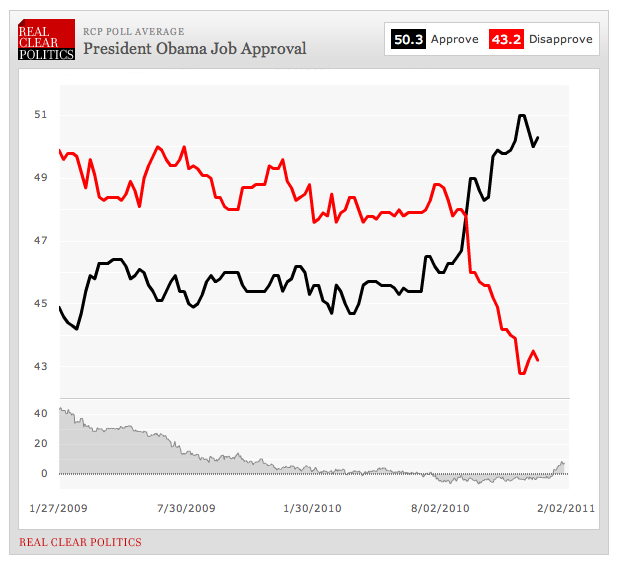
The only thing that is left to be seen is how successful Obama will be in realizing these goals. Having checked off nearly every initiative he proposed during his 2010 state of the union address – health-care reform, financial reform, and repeal of "Don't Ask, Don't Tell," among others – no one should doubt the abilities of an ambitious and dogged yet practical and ever-popular president like Obama.

Rather than dwelling on the apocalyptic anxieties of the masses, Obama has proposed common-sense policies that both quell the fears and fix the problems.

The era of violent rhetoric most likely has not passed with the Tucson shootings, but after this speech, maybe Republicans will begin to back their demagoguery with real solutions.

Talking problems to death is a luxury awarded only to the minority party. With Republicans now in control of the lower branch of Congress, they no longer are regarded as windbag obstructionists. They are actual lawmakers – the presumption and expectation being that they will now make laws.

They will keep the vitriolic rhetoric, as it is their only tool of influence over the masses anymore, but I bet that if we all sent hopes and prayers and meditations and curses and petitions and criticisms of the absence of any action behind all that anti-leftist tantrums, then perhaps Republicans at least might try to achieve a balance between the two.


(Cross-posted from Muddy Politics.) 

Thursday, January 27, 2011

Oh, Sarah Palin, you vulgar moron


Former Alaska GOP Gov. Sarah Palin said Wednesday night that President Barack Obama's call for "winning the future" during his State of the Union address is best framed by the acronym it shares with a much different phrase -- "wtf."

"That was a tough speech to sit through and try to stomach," Palin said during an interview with Fox News's Greta Van Susteren.

"His theme last night was wtf, winning the future," she continued. "I thought, okay, that acronym -- spot on. There were a lot of wtf moments throughout that speech."

Palin, seemingly pleased with her joke, repeated the line later in the interview while poking Obama for referencing Sputnik in another section of his address.

"That was another wtf moment," she said.

Say what you will about President's Obama's SOTU, it was a serious speech about serious issues intended for a serious audience at a serious time in America's history.

Far be it from Palin, however, to have any sense of history, any sense of public policy, any sense of the enormous problems America faces, any sense of the gravity of the moment.

She is so mind-bogglingly un-serious, so much so that she actually makes Michele Bachmann look bright.

As if we needed a further reminder, Sarah Palin is a moron.

**********

Update: And does she really think the Soviet Union won the space race? With that sort of ignorance, it's like she hates America or something. (Just imagine how Fox News would react if a Democrat said that.)

Wednesday, January 26, 2011

SOTU and Sputnik: Economic nationalism, political paralysis, and the decline of the American Empire


I haven't yet commented on last night's State of the Union address, nor on the Republican response, but, then, what more is there to say?

TNR's John Judis thinks it was President Obama's best speech as president. I do not agree, though I'm hard-pressed to name a better one. Not because I thought his SOTU was all that great but because he hasn't exactly given many memorable speeches as president.

Content-wise, I suppose a lot depends on what you think of Obama's economic nationalism, the core theme of last night's speech. The world is moving ahead and America is in decline. That decline is relative, as it is still on top, for the most part, but how long will it be before China and perhaps India take over?

In referencing Sputnik at the core of his speech, Obama was saying that America is now at a fork in the road, much as it was after the Soviet Union launched that first satellite into space. One road leads to further decline, one road leads to further superpowerdom:

Half a century ago, when the Soviets beat us into space with the launch of a satellite called Sputnik¸ we had no idea how we'd beat them to the moon. The science wasn't there yet. NASA didn't even exist. But after investing in better research and education, we didn't just surpass the Soviets; we unleashed a wave of innovation that created new industries and millions of new jobs.

This is our generation's Sputnik moment. Two years ago, I said that we needed to reach a level of research and development we haven't seen since the height of the Space Race. In a few weeks, I will be sending a budget to Congress that helps us meet that goal. We'll invest in biomedical research, information technology, and especially clean energy technology -- an investment that will strengthen our security, protect our planet, and create countless new jobs for our people.

I hardly count myself an economic nationalist, or a nationalist of any kind, and certainly not in American terms, but I do think that Obama is generally right about this. Private investment -- business -- is simply not enough. What is needed, as it was back in the '50s, is extensive government investment in everything from health care to education to research and development in next-generation technological innovation.

This is where conservatives get it wrong. No one is saying, let alone Obama, that business doesn't matter, or that government ought to replace business. We all acknowledge that businesses create jobs and for the most part keep the economy moving. But business, taken as a whole, simply does not have the big picture in mind. Business is about profit, about maximizing returns for shareholders. And that's fine. But sometimes you need, a society needs, government to step in and lead the way. Conservatives pretend that this is never the case, or perhaps have convinced themselves that government can never be the answer. This is historical revisionism, a failure to appreciate how American capitalism, and capitalism generally, has evolved over time.

As Slate's Fred Kaplan explains, huge government investment has been behind many of the most significant technological developments and innovations of recent decades, from space exploration (most notably JFK's pledge to go to the moon, ultimately realized less than a decade later) to the microchip to the Internet:

John Kennedy ran for president in 1960, promising a "new frontier" founded on "vigor." Early in his term, he directly responded to Sputnik in two ways: He poured money into the Minuteman ICBM program (both before and after he realized that the missile gap was a myth). And he pledged to land an American on the moon by the end of the decade.

In the spring of 1959, Texas Instruments had introduced a new technology called the microchip. But it was very expensive and generated no demand from the private sector. However, these tiny chips would be needed to power the guidance systems in the Minuteman's nose cone -- and in the coming Apollo program's space capsule.

It was the Pentagon and NASA that bought the first microchips. The demand allowed for economies of scale, driving down costs enough so that private companies started building products that relied on chips. This created further economies of scale. And so came the inventions of the pocket calculator, smaller and faster computers, and, decades later, just about everything that we use in daily life.

None of this was inevitable. It started only because of government investment. Obama made this same point in Tuesday night's address: "Our free enterprise is what drives innovation. But because it's not always profitable for companies to invest in basic research, throughout history our government has provided cutting-edge scientists and inventors with the support they need. That's what planted the seeds for the Internet. That's what helped make possible things like computer chips and GPS."

GPS was initially an Air Force program, designed to make bombs more accurate. The Internet was an internal communication program created by the Defense Advanced Research Projects Agency.

Obama could have gone back further. The first commercial computer, the IBM 1401 of the late 1950s, came about only because the first customers were government agencies, the Social Security program and the Veterans Administration, which required a computer with enough capacity to store data about the millions of Americans receiving government checks.

If conservatives like today's had had their way, none of this would have happened -- or, rather, it would have, but America likely would not have been the leader of the computer age, the American economy wouldn't have boomed as it did, and Americans, along with American businesses, wouldn't have reaped the benefits of such astonishing innovation.

Obama's speech was all about winning the future, as Slate's John Dickerson notes:

He described a challenge to the American dream: The promise of prosperity is threatened by technology and global competition. His pitch was aimed at those Americans "who feel like the rules have been changed in the middle of the game." After sketching this moment of uncertainty, he quickly moved to optimism, rallying the country to its strongest traditions of perseverance and affirming that Americans have always been able to shape their own destiny. His speech was practically a 12-step program for reconnecting the American people with the dream that animated the country at its beginning. 

There is a dark side to this, of course. Back in the '50s and '60s, there was a clear enemy, the Soviet Union, and Americans (and most westerners) rallied against it. But what is there now? According to Obama -- and he's right about this -- the real challenge to America (if not so much to the rest of the West) is not al Qaeda, or Islamism broadly, but emerging economic superpowers like China and India, and perhaps even Europe. A challenge is not necessarily the same as an enemy, but the risk is that the rest of the world will be seen now as the primary threat to America's future, if not to its survival then at least to its standing atop the world. And this would mean vilifying the Chinese and the Indians, among others. Nationalism, after all, isn't just about national pride and a focus on national interests but about exclusion, about "us" and "them." The world is getting smaller and smaller, but nationalism is about building walls, about driving people apart. Is that really the way to do?

Of course, many other governments invest heavily in domestic industry, and so, to an extent, the U.S. would (and should) be no different. So, fine. Go ahead and invest. The problem is, where is the investment going to come from? Beyond Obama's high-falutin' rhetoric, where is the political will for it happen?

Obama did not call for shared sacrifice but instead for bipartisanship. There's a huge difference. It was fairly easy, relatively speaking, to call for sacrifice when faced with the Soviet threat, but now? All President Bush told Americans to do after 9/11 was to go shopping. Obama still clings to the delusions of post-partisanship that characterized his campaign -- whether he actually believes such nonsense is not clear, but what else are we to take from his insistent rhetoric? -- and so merely asks Democrats and Republicans to work together to address the country's problems. He will do his part, as always, by reaching out across the aisle, but have we, has he, learned nothing of the first two years of his presidency. Republicans want no part of working with him or his party on anything. He might be able to peel off a Republican or two here and there, but the health-care debate is ample evidence that Republicans refuse to compromise in good faith.

And so, the merits of Obama's innovation-based approach aside, progress, it would seem to me, isn't likely. Dickerson notes that the president used the phrase "win the future," or a variant, 11 times in his speech. That means that the speech sounded very much like "a self-help seminar," one loaded with typically banal "tag lines from corporate marketing." Yes, he's for more government investment, perhaps akin to what happened in the '50s and '60s, but the message was presented at such a high level that it rang hollow. And as if that weren't enough, Obama indicated that he remains committed to the tax-cut, spending-cut fiscal conservatism of the political center. As Kaplan writes:

Obama proposed, starting this year, to "freeze annual domestic spending for the next five years," a step that, he boasted, would "bring discretionary spending to the lowest share of our economy since Dwight Eisenhower was president."

It's hard to see how he or the Congress can resolve this contradiction -- Kennedy-esque vigor and investment on the one hand, Ike-like torpor and penny-pinching on the other. He said much of this extra money could be freed up by eliminating subsidies for the oil companies. First, good luck on that. And second, that alone won't free up enough.

So where's the money going to come from? Even if he gets Democrats on board -- and he certainly won't get all of them -- there's no way Republicans are going to agree to massive government investment in anything, let alone when they mistakenly think voters gave them an anti-government mandate last year and when they plan on running along Tea Party lines in 2012.

Sure, this was the "old" Obama again, the one calling for the "hard choices" to be made and for bipartisanship to prevail, and he was generally quite effective, and, sure, Americans seem to like what they heard, but where exactly do we go from here? It sounded more like Obama was laying the groundwork for his re-election bid, presenting a nationalistic (and vaguely populistic) vision that appeals to independents, then he was presenting anything resembling a realistic policy agenda for the next two years. (As TNR's Jonathan Chait remarks, the president's "emphasis on public investment reflects less a desire to increase spending on infrastructure, R&D and the like than a platform from which to oppose anticipated Republican cuts.")

That's fine, I suppose -- he needs to run on something, after all -- but it just seems to confirm that nothing is actually going to happen. Even if Americans like what they heard, they don't want their taxes raised and they have a party, the GOP, that is fundamentally anti-tax and anti-government and that will appeal to them along those lines. Americans also oppose cuts to most government programs, including Social Security, of course, even if Republicans refuse to acknowledge this, and so as the country faces political intractability, and as the willingness to accept shared sacrifice is largely non-existent, there just isn't the money for what Obama wants.

Even if this is another Sputnik moment for America, the outcome will be very different. Obama will make his case, Republicans will make theirs, and nothing will change -- except, from time to time, the politicians voters send to Washington.

The decline of the American Empire, already in full swing, continues.


Top Ten Cloves: Things overheard during last night's SOTU


10. "We should pass a bill that mandates the SOTU be like Twitter -- 140 characters or less."

9. "I see that Kucinich brought his own sandwich tonight."

8. "Being the Bears fan that he is, I heard he might give Jay Cutler a medal or something."

7. "What's going to happen first, Joe Biden falling asleep or John Boehner crying?"

6. Someone claims Joe Wilson shouted out "Only thing missing is the Mighty Mouse theme music."

5. "Hey, get this, John Thune is going around telling people no way is he going to invest in Sputni."

4. "Well, at least Paul Ryan doesn't look like that 30 Rock page guy.)

3. "Did you see Palin called Reagan "America's Lifeguard" the other day? Is she trying to say Obama belongs at that Pennsylvania swimming club?"

2. "What's the difference between Obama and Taco Bell's meat? Nothing -- neither Taco Bell nor his speech has much beef."

1. "Instead of letting the Tea Party have her, maybe we should have Bachmann give our official response. What's the worst that could happen?"


(Cross-posted at The Garlic.)

Tuesday, January 25, 2011

Happy SOTU Day! (or, Obama on Social Security)


I have no doubt that Obama will present a largely centrist policy agenda in his State of the Union address tonight.

But I also hope that he will use the occasion to defend the Patient Protection and Affordable Care Act, one of the great accomplishments of his presidency so far (even if it's not as progressive as it ought to be), after the Republican House voted to repeal it last week, and that, on issues where he might actually get something done over the next two years, such as immigration reform and deficit reduction, he presents a vision that Democrats can get behind and ultimately use for electoral gain, a vision that at the very least doesn't further alienate progressives.

On the latter at least, deficit reduction, it seems we may get just that:

President Obama has decided not to endorse his deficit commission's recommendation to raise the retirement age, and otherwise reduce Social Security benefits, in Tuesday's State of the Union address, cheering liberals and drawing a stark line between the White House and key Republicans in Congress.

Over the weekend, the White House informed Democratic lawmakers and advocates for seniors that Obama will emphasize the need to reduce record deficits in the speech, but that he will not call for reducing spending on Social Security -- the single largest federal program -- as part of that effort.

*****

Administration officials said Obama is unlikely to specifically endorse any of the deficit commission's recommendations in the speech, but cautioned that he is unlikely to rule them off the table, either. On Social Security, for example, he is likely to urge lawmakers to work together to make the program solvent, without going into details, according to congressional sources.

Ah, so there's the out. It's sort of like how Obama was for the public option before he wasn't really for it or against it and it died. Or how he was against extending the Bush tax cuts for the wealthy until he cut a deal to allow just that. Now he's against cuts to Social Security, or so he will say tonight, but, well, who knows? He may just allow cuts to be made so as to win points somewhere else.

Oh, and by the way. Social Security is in good shape. The system isn't about to go bankrupt, as Bush alleged in his 2005 SOTU, and, as Paul Krugman has noted time and time again, there is no crisis. That's just a myth perpetuated by the right, by conservatives who want to privatize it and Republicans who want to cut it so that they can have their tax cuts.

If you really want to balance the budget, as Obama apparently does (even at this time of ongoing economic uncertainty, when frugality is hardly what is called for), the best thing to do is to return to the sensible tax levels of the Clinton era, particularly for the wealthy, and to cut military spending. It is not to target a successful program designed to help those who desperately need help.

But of course the poor and the desperate don't have nearly the political clout the rich do, and Obama, it seems, despite whatever he says tonight, will likely appeal directly to the centrist obsession with fiscal conservatism as this issue plays out over the next couple of years, leading up to the 2012 election.

Oh, I have high hopes that he says all the right things tonight, but he's already signalled what his priorities are, and what his politics are, and there's no reason to think that he will actually advance anything even resembling a progressive vision for America, on Social Security or anything else -- at least until the campaign, when he'll need to win some of us back.